প্রকাশের তারিখ : ০৬ সেপ্টেম্বর ২০২৬
Measles-Dengue surge strains health system
||
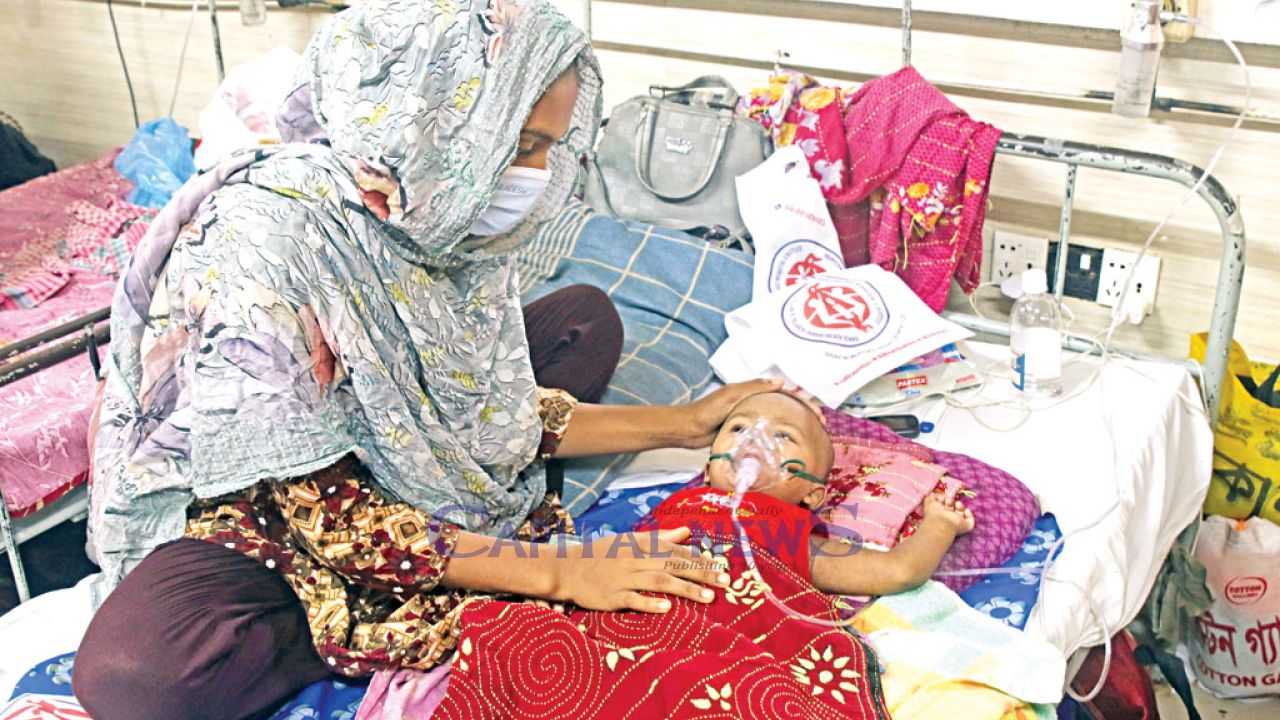
Bangladeshi public health experts have called on the government to declare a national public health emergency as measles test positivity hit its highest on record in August, compounding the country's worst dengue outbreak so far this year, while pushing an already strained hospital system towards the breaking point.Nearly 8,000 patients with dengue or measles are currently being treated in hospitals nationwide, at a time when many public hospitals were already operating to more than double their sanctioned capacity even before the twin outbreaks took hold. The average bed occupancy at district hospitals and public medical college hospitals has remained above 160 per cent over the year, according to the Directorate General of Health Services - leaving little room to absorb the current surge.The crisis is compounded by a severe shortage of life-saving infrastructure.Most upazila health complexes have no oxygen support, let alone intensive care facilities, meaning that even moderately severe cases requiring hospitalisation must be transferred to district-level hospitals where the ICU capacity remains very limited.Physicians assume that 2 per cent of the total hospitalised cases with either of the both diseases could need intensive care, raising the apprehension that a large number of patients may be forced to travel to Dhaka for treatment in the weeks ahead. Bangladesh now has 1,372 ICU beds at 72 public healthcare facilities and 1,054 CCU beds at 51 facilities, which are far lower than the standard requirement.Half of them remain dysfunctional for staff shortage or technical problems.'The government should strengthen primary healthcare at the upazila level so that most patients do not have to go to higher-level hospitals with complications. Otherwise, the existing crisis in healthcare facilities will become more severe,' said Mohammad Mushtuq Husain, a public health expert and former adviser at the Institute of Epidemiology Disease Control and Research.Mushtuq said that adequate intensive care facilities could not be achieved overnight but efforts could be made to keep the diseases from getting worse by ensuring primary care.He also urged the government to immediately declare a national public health emergency to ensure better coordination and a stronger response to the outbreaks.The IEDCR defines a public health emergency as a health crisis (such as a severe disease outbreak, natural disaster, or contamination) that has exceeded the normal operating capacity of the country's regular healthcare system. The Infectious Diseases (Prevention, Control and Eradication) Act, 2018 was designed to raise awareness of, prevent, control, and eradicate infectious or communicable diseases in addressing public health emergencies and reducing health risks by empowering the health authority.The renewed alarm - over the two diseases - follows fresh laboratory data that show Bangladesh recorded its highest-ever measles test positivity rate - 64.6 percent - in August, despite running a mass measles vaccination campaign and a parallel vitamin A drive earlier in the year.The figure marks a sharp reversal.Positivity rates had been declining from May through July, falling from 59.92 per cent in May to 51.59 per cent in June and 47.42 per cent in July, before climbing again in August.'It is alarming that measles has increased even after the mass vaccination campaign, as it is a vaccine-preventable disease,' said professor Nazrul Islam, a virologist and former vice-chancellor of Bangladesh Medical University.The National Polio and Measles-Rubella Laboratory, under the Institute of Public Health, has recorded an average positivity rate of 53.39 per cent from the samples tested since April, with 39,639 samples tested in total, including 6,394 in August alone.DGHS figures show 133 deaths and 32,062 confirmed and suspected measles infections in August, compared with 121 deaths and 31,081 infections in July, and 131 deaths and 32,996 infections in June. In May, at the campaign's peak, 308 deaths and 37,717 infections were recorded.AM Zakir Hossain, IEDCR director and DGHS line director for primary healthcare and disease control, called the rise in test positivity 'alarming', particularly given the scale of the recent vaccination campaign.Experts note that the measles vaccine typically takes several weeks to generate adequate antibody protection and case numbers should, in principle, start falling in the weeks following the campaign rather than climbing further - a pattern Hossain said raises questions over both the vaccination coverage and the campaign's overall effectiveness. The measles resurgence coincided with the country's most severe dengue outbreak of 2026 to date. The DGHS recorded 20,536 dengue hospitalisations in August alone - the highest monthly total in three years - along with 43 deaths. The pressure has not eased since.In the first five days of September, daily dengue hospitalisations averaged more than 1,000, with an average of three deaths per day. As of Saturday, a cumulative 41,032 dengue patients were hospitalised this year, with 113 deaths recorded.Nationally, DGHS data show 5,293 patients were being treated for measles and 2,740 for dengue as of Saturday, with 1,909 new admissions for the two diseases recorded in the preceding 24 hours alone. The scale of the strain is visible at Bangladesh's flagship public hospitals.Dhaka Medical College Hospital, the country's largest public health facility with a sanctioned capacity of 2,600 beds, was treating more than 4,200 inpatients on Saturday, as of the latest count - including 36 dengue and 153 measles patients.Bangladesh Shishu Hospital and Institute, the country's only specialised children hospital, was treating 102 measles and 28 dengue patients on Saturday against its 680-bed capacity.DGHS hospital wing director Md Nurul Islam acknowledged the mounting pressure across the country's 665 public hospitals, which collectively have around 72,000 beds.'Patient burden has been increasing by the day. We are concerned and are already assessing where and how many beds we can add,' he said, indicating that authorities were exploring options to expand the capacity at existing facilities rather than waiting for new infrastructure to come online.With both outbreaks showing no clear sign of abating - dengue at its highest monthly toll in three years and measles positivity climbing even after a nationwide vaccination push - public health specialists warn that the coming weeks will test whether the health system of Bangladesh, already running well beyond its designed capacity, can withstand a further surge without a coordinated national response.
© 2025 The Daily Capital News