প্রকাশের তারিখ : ০২ নভেম্বর ২০২৬
Muslim families displaced, mosques and religious structures bulldozed in BJP-ruled Assam
||
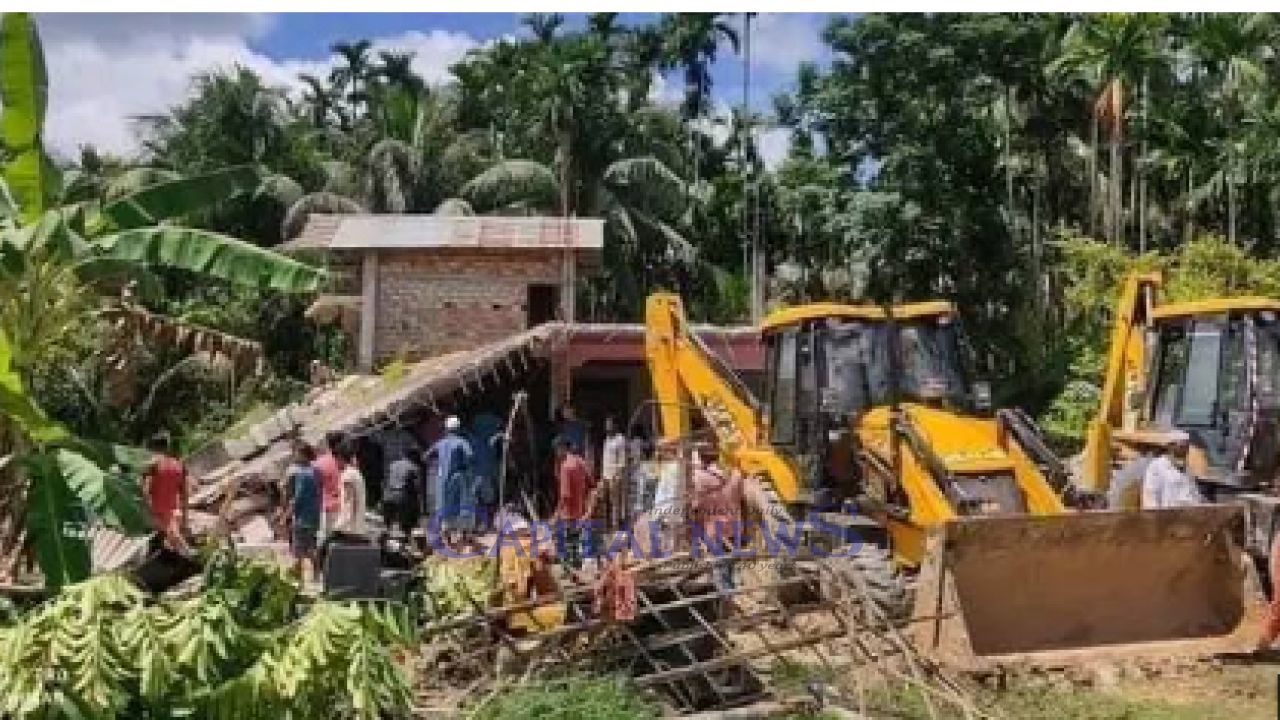
CN Desk: A massive eviction drive in Assam’s Dhubri district has displaced hundreds of predominantly Bengali-origin Muslim families, with bulldozers and heavy machinery deployed to clear approximately 650 bighas of land in the Alamganj Part-IX area under the Gauripur Revenue Circle.The operation, conducted on November 1 under the BJP-led Assam government, triggered scenes of distress as residents watched their homes and community structures being demolished. Women were seen crying and offering prayers near a mosque as bulldozers moved through the area, while other residents gathered near religious sites and graveyards in grief.According to reports published by NDTV, Scroll and India Today NE, the eviction operation involved more than 50 excavators and a substantial police deployment.Reports on the eviction drive cited different figures regarding the number of affected households. The Dhubri district administration said approximately 550 families were being evicted from 650 bighas of land, while other media reports referred to more than 640 families and up to 750 families in the wider operation. The administration maintained that the land belonged to the government and that the eviction followed notices and administrative proceedings.However, residents have disputed aspects of the government’s position, with some claiming long-standing connections to the land and questioning their treatment and the availability of alternative accommodation.According to Scroll, more than 4,000 people were displaced after the demolition of homes belonging to over 640 Bengali-origin Muslim families.The operation also affected religious and community structures, including mosques, places of worship and graveyards, according to media reports.Heartbreaking scenes emerged from Alamganj as women and other residents were seen crying, praying and making supplications while heavy machinery carried out demolitions.Videos circulated in the media showed residents offering prayers at a mosque and breaking down near a shrine as the eviction operation continued.The scenes have raised serious humanitarian questions about the consequences of large-scale demolitions, particularly when vulnerable families face the loss of their homes, neighbourhoods and places of worship.For many affected residents, the issue extends beyond the loss of property. It concerns their security, dignity, religious identity and ability to rebuild their lives.The latest operation has renewed criticism of the BJP-led Assam government’s eviction policies, which have disproportionately affected Bengali-origin Muslim communities.According to reporting by Reuters in July 2025, thousands of Bengali-speaking Muslim families had been evicted from their homes in Assam, with officials accusing residents of occupying government land or being illegal immigrants. Many affected residents maintained that they were Indian citizens, while activists raised concerns about the targeting of vulnerable communities.Reuters reported that approximately 50,000 people, mostly Bengali Muslims, had been affected by eviction operations since the BJP government came to power in Assam in 2021.Critics argue that the repeated use of bulldozers against predominantly Muslim settlements, combined with political rhetoric questioning the identity and citizenship of Bengali-origin Muslims, has created an atmosphere of insecurity among the community.The central concern remains whether eviction procedures, legal protections and rehabilitation arrangements are being applied fairly and without religious or ethnic discrimination.Beyond demolitions and displacement, concerns have also emerged about the electoral rights of evicted Muslim communities in Assam.An investigation published by Scroll on February 21, 2026, reported that thousands of displaced Bengali-origin Muslims faced difficulties retaining or restoring their names on electoral rolls after their homes were demolished.The investigation identified approximately 5,700 potentially affected voters in Dhubri and Uriamghat. It reported that around 756 voter names had been removed from four polling stations in Dhubri and another 4,945 names from five polling stations in Uriamghat.Affected residents said that displacement had made it difficult to establish their addresses and maintain their voter registration.Separately, Human Rights Watch, in an October 29, 2026 report on India’s electoral-roll revisions, raised concerns about flawed procedures, arbitrary exclusion and disproportionate difficulties for marginalised communities. It also documented concerns about attempts to remove Muslim voters through bulk objections.These developments raise serious questions about the protection of citizenship rights, voting rights and equal treatment under the law.Losing one’s home should not mean losing one’s political voice or the ability to participate in democratic processes.The developments in Assam form part of a wider national debate about the treatment of religious minorities under BJP-led governments.Muslims, Christians, Dalits and other marginalised communities, alongside journalists, activists, academics and independent voices, have raised concerns about discrimination, intimidation, restrictions on dissenta and the increasing influence of Hindutva politics in public life.Critics of the BJP and the Rashtriya Swayamsevak Sangh (RSS) argue that the political promotion of Hindutva has contributed to an increasingly polarised environment in which religious minorities feel vulnerable and excluded.Concerns have particularly focused on anti-Muslim political rhetoric, demolitions affecting Muslim communities, challenges to religious and cultural identity, and questions surrounding equal citizenship.These concerns deserve serious public scrutiny, particularly when government policies affect people’s homes, livelihoods, religious institutions and constitutional rights.
© 2025 The Daily Capital News