প্রকাশের তারিখ : ০৬ নভেম্বর ২০২৬
Dr Shafiqur Rahman calls for unity to uphold democracy, people’s rights
||
Jamaat
chief says November 7 spirit must guide state governance; urges implementation
of July Charter and referendum verdictMM
Rahmatullah: Jamaat-e-Islami
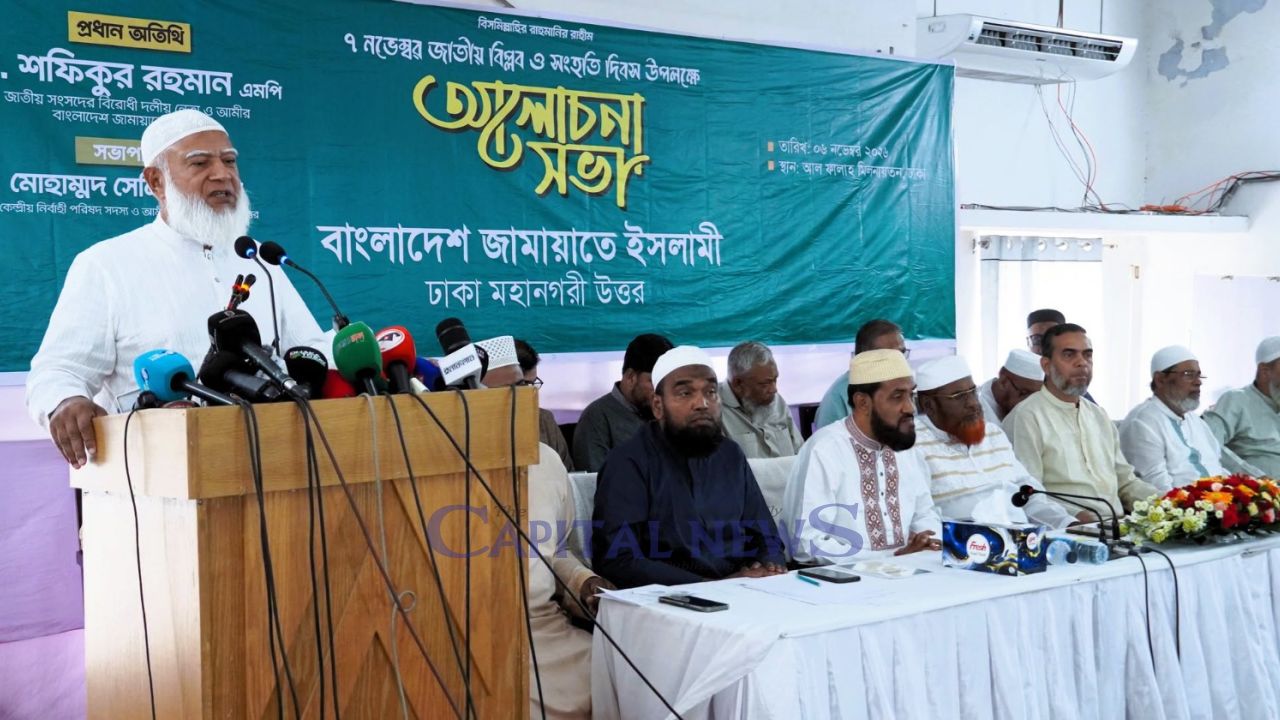
Ameer and Leader of the Opposition Dr Shafiqur Rahman has called for national
unity to establish democracy, justice and people's rights, saying the spirit of
November 7 represents a struggle against injustice, authoritarianism and the
denial of democratic freedoms.“Those
who ignore the expectations and rights of the people will not be forgiven by
history,” he said while addressing a discussion meeting marking the National
Revolution and Solidarity Day, organised by Jamaat-e-Islami's Dhaka North city
unit in the capital on Friday.The
meeting was held at Al-Falah Auditorium at 10:30am, with Jamaat Secretary
General and former MP Mia Golam Parwar as a special guest. Dhaka North city
unit Ameer Mohammad Selim Uddin presided over the programme.Dr
Shafiqur Rahman said the country's political history offered repeated lessons
about the consequences of authoritarian rule, suppression of opposition voices
and the denial of citizens' fundamental rights.Recalling
the political developments of the early years after independence, he alleged
that the then government imposed restrictions on political and religious
organisations, weakened accountability and allowed widespread abuses of power.
He also accused the administration of suppressing dissent, corruption, looting
and extrajudicial killings.Referring
to the political developments of 1975, he said the establishment of the
one-party BAKSAL system on January 25 that year had undermined multiparty democracy
and restricted press freedom.He
also recalled the political and military developments between August 15 and
November 7, 1975, saying the country experienced successive power shifts and
uncertainty during that period.According
to him, after the November 3 counter-coup led by Brigadier Khaled Mosharraf,
Ziaur Rahman remained under detention until November 7, when soldiers organised
to secure his release. He
said soldiers took to the streets with tanks in the early hours of November 7,
while people coming out of mosques after prayers welcomed them with slogans of
Takbir. Similar developments took place in several important cities, he added.“The
soldiers carried out the revolution, while the people expressed solidarity with
it. That is why the day is known as National Revolution and Solidarity Day,” he
said.The
Jamaat chief also stressed the need to recognise the contributions of different
individuals and political groups to the country's Liberation War and
independence movement, saying no single person or party could claim exclusive
ownership of the nation's history.He
said political differences should not prevent recognition of the contributions
made by people at different stages of the struggle for independence.Referring
to the political transition of 1990, he said people had again taken to the
streets against misrule, corruption and inefficiency. He also highlighted the
importance of political compromise, dialogue and flexibility in ensuring
democratic stability.Turning
to the current political situation, Dr Shafiqur Rahman urged the government to
respect the outcome of the referendum and implement the commitments made to the
people before the election.He
alleged that several reform initiatives introduced through 133 ordinances by
the interim government had not received adequate parliamentary consideration.
He expressed concern over the cancellation of 20 ordinances, arguing that their
retention could have helped prevent the return of authoritarian practices.He
further accused the government of attempting to establish partisan control over
important public institutions, including universities, district councils, city
corporations and constitutional bodies.Criticising
what he described as politically motivated appointments, he said public
institutions must be led by competent and impartial individuals rather than
people selected on the basis of party affiliation.He
also expressed concern over developments involving the Public Service
Commission, alleging that its chairman had been removed and other members were
facing pressure to leave their positions.The
opposition leader said students had taken part in movements demanding
merit-based recruitment and equal opportunities, and warned that political
patronage in public employment would undermine the prospects of the country's
young generation.On
the role of the opposition, he said Jamaat-e-Islami wanted Parliament to
function effectively and would cooperate with the government on justified
issues while opposing decisions it considered unjust.He
also criticised the government's approach to restructuring the Rapid Action
Battalion (RAB), saying changing the force's name while retaining its existing
personnel and structure would not resolve the underlying problems.He
suggested that the government could take time for consultation and develop a
new law enforcement structure with competent and patriotic personnel.Dr
Shafiqur Rahman reiterated that the July Charter and the referendum verdict
must be implemented in line with the people's mandate.He
said the country's future depended on meaningful reforms, accountability and
the protection of democratic rights, adding that authoritarianism was not
confined to any particular political party but could emerge whenever those in
power ignored public interests.He
also referred to the July-August 2024 mass uprising, describing it as an
important event in the country's political history. He said Jamaat-e-Islami had
not claimed exclusive credit for the movement and had tried to stand beside the
families of those killed and people injured or disabled during the protests,
irrespective of their political identities.Calling
for a clear government position on issues involving national interests,
including the proposed Matarbari-related matters, he warned against agreements
or decisions that could undermine Bangladesh's sovereignty and national
interests.He
said the country's young generation and people would reject domination and
stand for an independent nation based on justice, accountability and equal
rights.“Until
a genuinely independent and justice-based state is established, our movement
and political struggle will continue,” he said.Speaking
as a special guest, Jamaat Secretary General Mia Golam Parwar said November 7
should not be viewed merely as a military event, arguing that it was also
linked to public resentment over one-party rule and the denial of democratic
and civil rights.He
called on the government to respect people's voting rights and democratic
aspirations and implement the July Charter and referendum verdict.In
his presidential address, Mohammad Selim Uddin said the aspirations for an
equitable and democratic Bangladesh that emerged after independence had yet to
be fully realised.He
said the 2024 mass uprising had sought not merely a change of government but
fundamental reforms in the state and society.Warning
that extortion, corruption, market syndicates, partisan control and public
suffering could undermine those aspirations, he called for collective efforts
to establish a just, accountable and discrimination-free Bangladesh.The
programme was conducted by Nazim Uddin Mollah, a central Majlish-e-Shura member
and assistant secretary of the Dhaka North city unit.
Among
others, Assistant Secretary General Advocate Ehsanul Mahbub Zubayer, Dhaka
North city unit Nayeb-e-Ameer Abdur Rahman Musa, Engineer Golam Mostafa,
Assistant Secretary Mahfuzur Rahman, Dr Fakhruddin Manik and Yasin Arafat
addressed the meeting.
© 2025 The Daily Capital News