

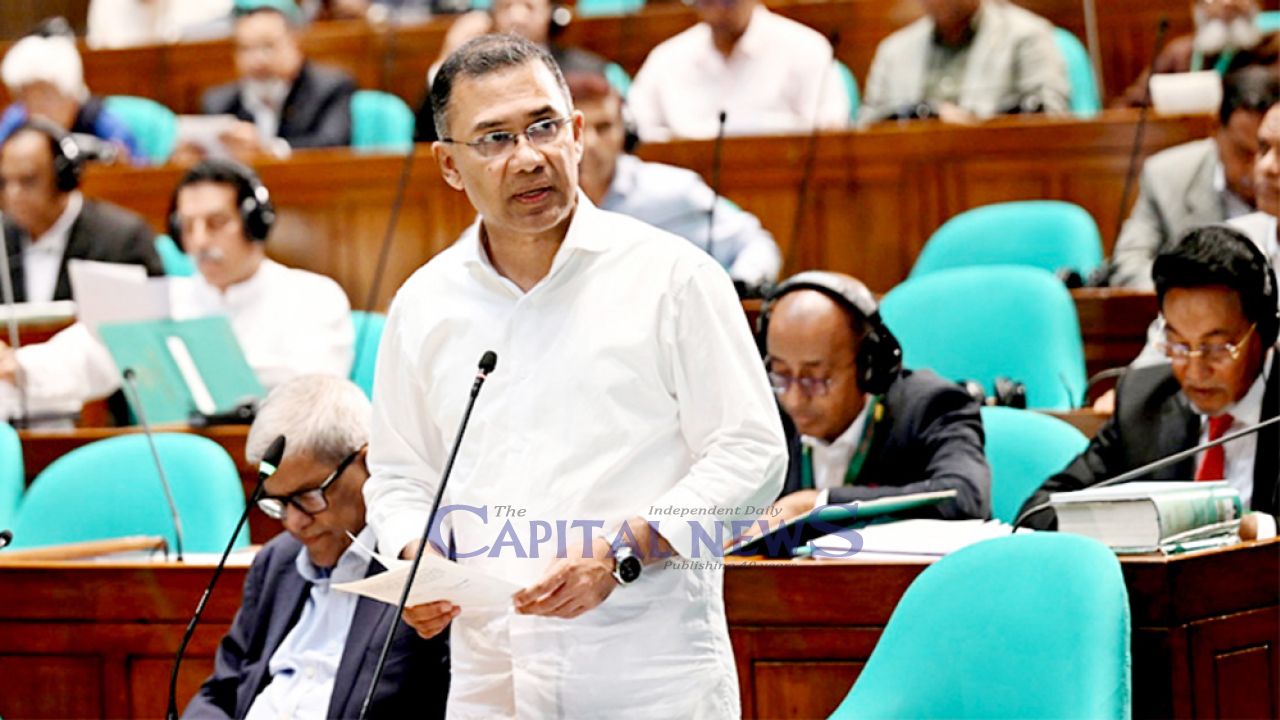
Parliament Correspondent: Prime Minister (PM) Tarique Rahman told parliament on Wednesday that his administration considers families rather than individuals as the core building blocks of national development, outlining an ambitious social protection initiative targeting four crore households nationwide.
Responding to questions in the Jatiya Sangsad, the BNP chairman and government leader articulated his party's governing philosophy emphasizing family units as fundamental development targets rather than focusing on individual citizens. The Prime Minister explained that the Family Card program emerged from this family-centric vision designed to establish comprehensive social security coverage for citizens through household-level intervention. Tarique detailed that initial implementation occurred March 10, 2026, when authorities distributed Family Cards to 37,814 households across ten districts and three city corporations as the program's pilot phase.
In a separate response to parliamentary questions, Tarique affirmed his government's dedication to advancing women's educational opportunities, empowerment, and equal access to learning institutions at all levels.
The Prime Minister announced that authorities are actively considering nationalizing one women's college in every upazila headquarters to advance gender equity objectives in education.
Ekramul Bari Tipu, representing Naogaon-4 constituency from the government benches, raised the query regarding women's education policies that prompted this response.
Directly addressing the Naogaon legislator, Tarique indicated the government would pursue gradual nationalization of qualifying educational facilities including Manda Thana Adarsha Girls' School and College in Naogaon district, subject to compliance with established policies and availability of necessary budgetary allocations.
The announcements signal the administration's strategic pivot toward household-based welfare delivery mechanisms while simultaneously prioritizing gender-focused educational expansion as core policy priorities during the current parliamentary term.
Earlier, in another response to Sirajganj-1 constituency lawmaker Md Salim Reza, PM informed the Jatiya Sangsad (JS) that the government is implementing short, medium, and long-term plans by identifying 43 key areas in the education sector, aiming to increase budget allocation to 5 percent of GDP in the sector.
He said that the current democratic government considers education as the best investment for the nation and remains committed to building a quality, life-oriented, and inclusive education system. He also said that the government's election manifesto outlined a plan to gradually increase allocation for education to 5 percent of GDP.
"In line with that target, the government is implementing short, medium and long-term plans after identifying 43 areas in the education sector," the Leader of the House said, adding that special importance has been given to improve the quality of primary education in the manifesto. As part of the government initiatives, free school uniforms will be distributed among 200,000 primary school students across the country within the current fiscal, he said, adding, the government has a plan to expand this initiative in all upazilas across the country gradually. To meet the nutritional needs of primary school students, the Prime Minister said there is a plan to provide school feeding/mid-day meals in all upazilas in phases.
Highlighting the government's plans for the education sector, Tarique Rahman said that as per the election pledges, multimedia classrooms will be set up in all primary, secondary, and equivalent educational institutions to prepare the new generation for global competition. To reduce digital disparity, he said, initiatives are underway to provide free Wi-Fi connectivity in 1,500 institutions (secondary schools, colleges, and universities) and a unique digital identity or 'Edu-ID' for every student and teacher.
Noting that the ruling party has made commitments in its election manifesto to make technical education mandatory for all alongside general education at the secondary level, the premier said his government has plans to gradually establish technical schools and colleges in every upazila and polytechnic institutes in every district.
Apart from making the technical and madrasah education modernized, Tarique Rahman said within the next 180 days, free Wi-Fi will be launched in 2,336 technical institutions and 8,232 madrasahs.
To make the madrasah education modernized and time-befitting, he said, smart classrooms will be established, training will be provided to enhance the skills of teachers, and technical courses will be included in madrasah education.
The Leader of the House said under the ICT Division's Bangladesh Computer Council, initiatives have been taken to provide training to students within the next six months in areas such as artificial intelligence, cyber-security, mobile app development and design using Flutter, Python programming, and web-based digital marketing.
Looking ahead, the government plans phased expansion to eventually encompass approximately 40 million marginalized and low-income families throughout the country, representing a massive scaling of social assistance infrastructure. Addressing the specific constituency of Noakhali-1 covering Chatkhil and Sonaimuri upazilas, the Prime Minister expressed optimism that women from economically disadvantaged families in those areas would soon receive Family Card benefits aimed at fostering empowerment and economic independence.
Subject : Parliament
বৃহস্পতিবার, ০৯ এপ্রিল ২০২৬
Publish Date : 09 April 2026

Write Your Opinion