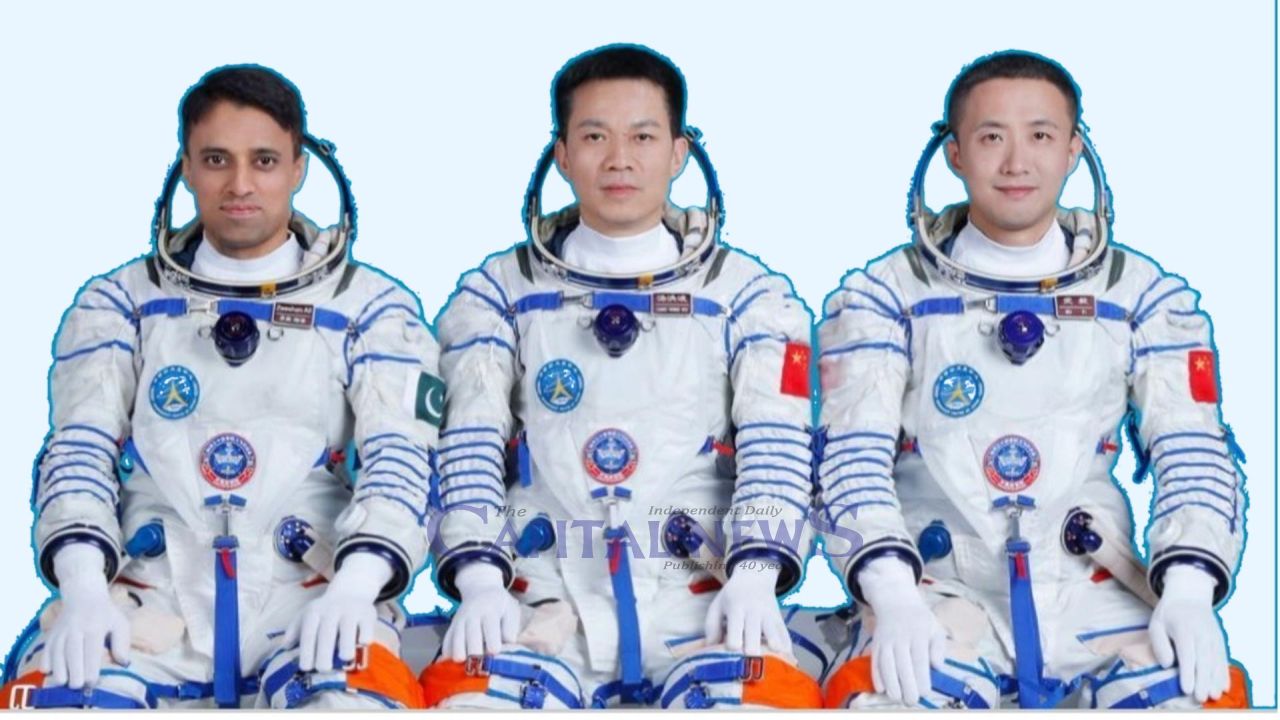
Pakistan reaches for the stars: First Pakistani Astronauts to fly to China's Space Station
Desk Report by MM Rahmatullah: History is about to be written 400 kilometres above the Earth, and Pakistan will be part of it.For the first time ever, a Pakistani astronaut will travel to space aboard a Chinese spacecraft and live and work on China's Tiangong Space Station.The astronaut is Muhammad Zeeshan Ali, 40. He will fly on Shenzhou-24, scheduled to launch on Wednesday morning from the Jiuquan Satellite Launch Center in northwest China, along with two Chinese astronauts, Tang Hongbo, 51, and Wu Yi, 39.This is not just a space flight. For Pakistan, it is a moment of national pride, a diplomatic milestone, and an economic opportunity all rolled into one.According to China's Manned Space Agency, this will be the first joint flight involving Chinese and foreign astronauts in the history of China's manned space programme.Zeeshan Ali will fly as a payload specialist. During his short stay in orbit, he will look after daily operations on the station and, more importantly, conduct four scientific experiments for China-Pakistan cooperation, mainly in biotechnology and materials science.One of his key tasks will be an in-orbit experiment on photosynthetic microorganisms, tiny living organisms that use light like plants do. Scientists believe such research could one day help produce food, oxygen and medicine in space, and also help agriculture and medicine back on Earth.After completing his mission, he will return to Earth aboard the Shenzhou-23 spacecraft.The flight is part of an agreement signed by China and Pakistan in February 2025. It shows that the famous all-weather friendship between the two countries has now reached space.While the United States and China are competing to return to the Moon, China aims for 2030, NASA for 2028, Pakistan has now positioned itself as China's first international space partner.Space is no longer just about rockets. It is a trillion-dollar economy of the future, satellite communication, weather forecasting, disaster management, agriculture, internet, and scientific research.For Pakistan, a country facing floods, climate change and food security challenges, space science can directly help farmers predict weather, help authorities manage disasters, and help students enter high-tech jobs.Training a Pakistani astronaut in China also means technology transfer, training of engineers, and new opportunities for Pakistan's space agency, SUPARCO, and its universities.A child in Lahore, Karachi, Peshawar or Quetta can now look up and say, a Pakistani has gone to space.That inspiration matters. Countries that invest in science create doctors, engineers, and innovators. Today's space mission could be tomorrow's jobs in IT, biotechnology, and engineering for Pakistan's youth.The mission will be commanded by Tang Hongbo, who has already flown twice before. He will become the first astronaut to board the Tiangong station three times. His experience will guide the first-time flyer Wu Yi and Pakistan's Zeeshan Ali.For Zeeshan Ali, this is more than a personal achievement. He is carrying the hopes of 240 million Pakistanis, and the flag of a nation that wants to be seen not just as a recipient of aid, but as a partner in science and progress.As the Shenzhou-24 lifts off, Pakistan will not just be watching a rocket. It will be watching its future take flight.