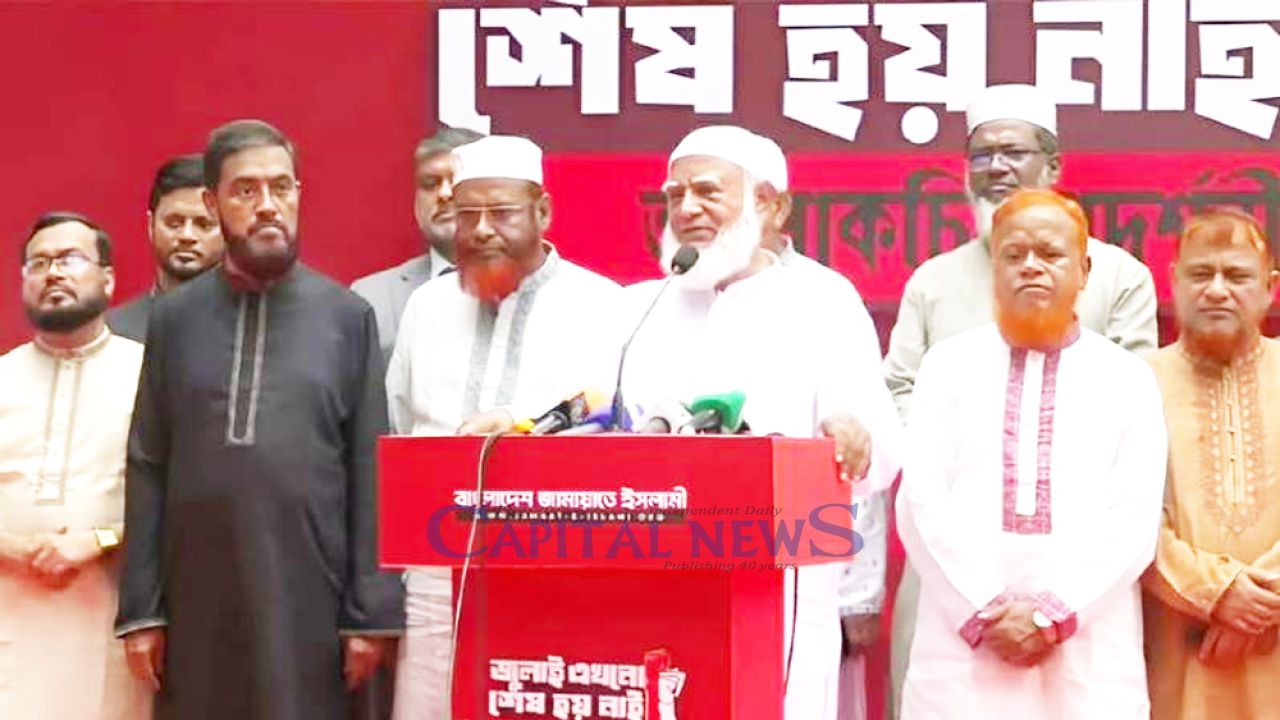
Jamaat photo exhibition draws heat over Zia’s absence
MM Rahmatullah: A photo exhibition organised by Jamaat-e-Islami at the official residence of its Ameer, and opposition leader of the parliament Dr Shafiqur Rahman, has sparked a fresh political controversy after photographs and references to several major events of Bangladesh’s history were displayed without any mention of the declaration of independence by Shaheed President Ziaur Rahman.Titled “July is Not Over Yet,” the exhibition featured photographs relating to the March 7 speech, the 1971 Liberation War and various political movements in Bangladesh. It also included images of Sheikh Mujibur Rahman and other historical figures.But the absence of any photograph, speech or reference to Ziaur Rahman’s declaration of independence has drawn criticism from political circles and social media users.The controversy has become more significant because Jamaat-e-Islami itself has previously spoken about Ziaur Rahman’s role in the declaration of independence.On December 16, 2024, at a Victory Day rally organised by Jamaat-e-Islami Dhaka City South in Paltan, Jamaat Ameer Dr Shafiqur Rahman questioned why Ziaur Rahman, whom he described as the declarer of independence, had not been given due recognition. He also questioned when and where Sheikh Mujibur Rahman had declared independence.That earlier position has now resurfaced in public discussions following the exhibition.BNP Senior Joint Secretary General Ruhul Kabir Rizvi, speaking on Saturday, questioned the omission of what he described as an important chapter of the Liberation War history.He said the exclusion could not simply be viewed as a coincidence and suggested that it carried political significance. He also said the incident had raised questions among the public about emerging political equations.The BNP has long maintained that Ziaur Rahman played a major role in the country's Liberation War and in the declaration of independence. His supporters also argue that his contribution was deliberately downplayed during the previous Awami League government.The latest controversy has therefore reopened an old and highly sensitive political debate over how the Liberation War and the declaration of independence should be presented in Bangladesh's public and political discourse.Jamaat Ameer Shafiqur Rahman, however, has rejected the suggestion that the exhibition was intended to present a complete history of Bangladesh.According to him, the exhibition was designed to portray the continuity of public movements against authoritarian and fascist rule. It was not intended to document every major event or personality in the country's political history.Explaining Ziaur Rahman's absence, Shafiqur Rahman said Zia was not included because he was not considered an authoritarian ruler.The explanation, however, has failed to end the debate.Critics are asking why a number of historical events and personalities connected with the Liberation War were included if the exhibition was not intended to provide a complete historical account. They argue that once the Liberation War becomes part of such an exhibition, excluding a major figure associated with the declaration of independence naturally invites questions.Leaders of the National Citizen Party (NCP) have also commented on the issue.Dr Atiq Mujahid, newly elected Member of Parliament for Kurigram-2 and an NCP Central Joint Convener, said the exhibition was not designed as a comprehensive presentation of the history of Bangladesh's Liberation War.He said its primary purpose was to portray how the Awami League developed into an autocratic and authoritarian political force.At the same time, Mujahid acknowledged that if the complete history of Bangladesh were being presented, Ziaur Rahman's declaration of independence should certainly have been included.NCP Joint Convener Sarwar Tushar, in a brief reaction, said: “We want the undistorted history of the Liberation War.”His comment reflects a broader demand emerging from the controversy: that political parties should present Bangladesh's history without selectively highlighting or omitting politically inconvenient chapters.The controversy does not end with Ziaur Rahman's absence.Another major question concerns Jamaat-e-Islami's own role during the 1971 Liberation War.Since the exhibition included references to the Liberation War, critics are asking why it did not address Jamaat's political position and activities during that period.Jamaat's role in 1971 remains one of the most controversial chapters in Bangladesh's political history. The party and its leaders have faced sustained criticism over their position during the Liberation War, while the issue has remained deeply connected to subsequent political conflicts in the country.Critics argue that if an exhibition seeks to portray the country's political struggles and historical movements, uncomfortable aspects of a political party's own history cannot simply be left outside the discussion.The question being raised is therefore broader than the absence of one photograph: How should a political party present history when that history contains both its own political legacy and its opponents' contributions?The contrast between Shafiqur Rahman's December 2024 remarks and the latest exhibition has intensified speculation over whether Jamaat-e-Islami's position regarding Ziaur Rahman's declaration of independence has changed.In December 2024, Shafiqur Rahman publicly questioned why Ziaur Rahman's role had not received recognition. In the latest exhibition, however, there was no visible reference to Ziaur Rahman or his declaration of independence.Jamaat maintains that there is no contradiction between the two positions.Its argument is that the December 2024 remarks concerned historical recognition, whereas the current exhibition has a different theme—authoritarian rule and the continuity of popular resistance against it.Whether the public accepts that explanation remains an open question.The controversy comes at a politically important time.Following August 5, Jamaat-e-Islami succeeded in developing a comparatively positive image among sections of the public. The party has increasingly sought to present itself as part of Bangladesh's changing political landscape.Against that backdrop, analysts believe that ambiguity over highly sensitive historical issues could create difficulties for the party.For younger Bangladeshis in particular, debates over the Liberation War are not simply questions about old photographs or political speeches. They concern national identity, independence and the historical foundation of the state.Political parties therefore face a difficult challenge: they must explain their positions on history clearly while avoiding selective narratives that may appear to serve immediate political interests.The “July is Not Over Yet” exhibition has consequently developed into a debate far larger than the display itself.At its centre are several interconnected questions: What role did Ziaur Rahman play in the declaration of independence? How should the contributions of different political and military figures to the Liberation War be recognised? How should Jamaat-e-Islami explain its own position and role in 1971? And should political parties be judged by whether their historical narratives remain consistent over time?These questions have particular importance in Bangladesh, where the history of the Liberation War remains closely linked to political legitimacy.The dispute also demonstrates how easily historical presentation can become a political issue. A photograph that is included—or left out—can carry a meaning far beyond the walls of an exhibition.Jamaat says the exhibition was never intended to be a complete history of Bangladesh and that its focus was the struggle against authoritarian rule. Critics, however, argue that the selective presentation of historical events creates legitimate questions about political consistency and transparency.For now, the party faces pressure to clarify its position on three sensitive issues: the Liberation War, the declaration of independence and its own role in 1971.Ultimately, the controversy is not simply about whether Ziaur Rahman's photograph appeared at an exhibition. It is about how Bangladesh's political parties choose to remember, explain and acknowledge the country's defining historical events.In a country where history continues to influence political identity, public trust and electoral legitimacy, selective silence can be as politically powerful as an explicit statement.The coming months may therefore show whether Jamaat's explanation is enough to settle the controversy—or whether the exhibition has opened a much wider debate over the party's evolving position on Bangladesh's Liberation War and the history of independence.