

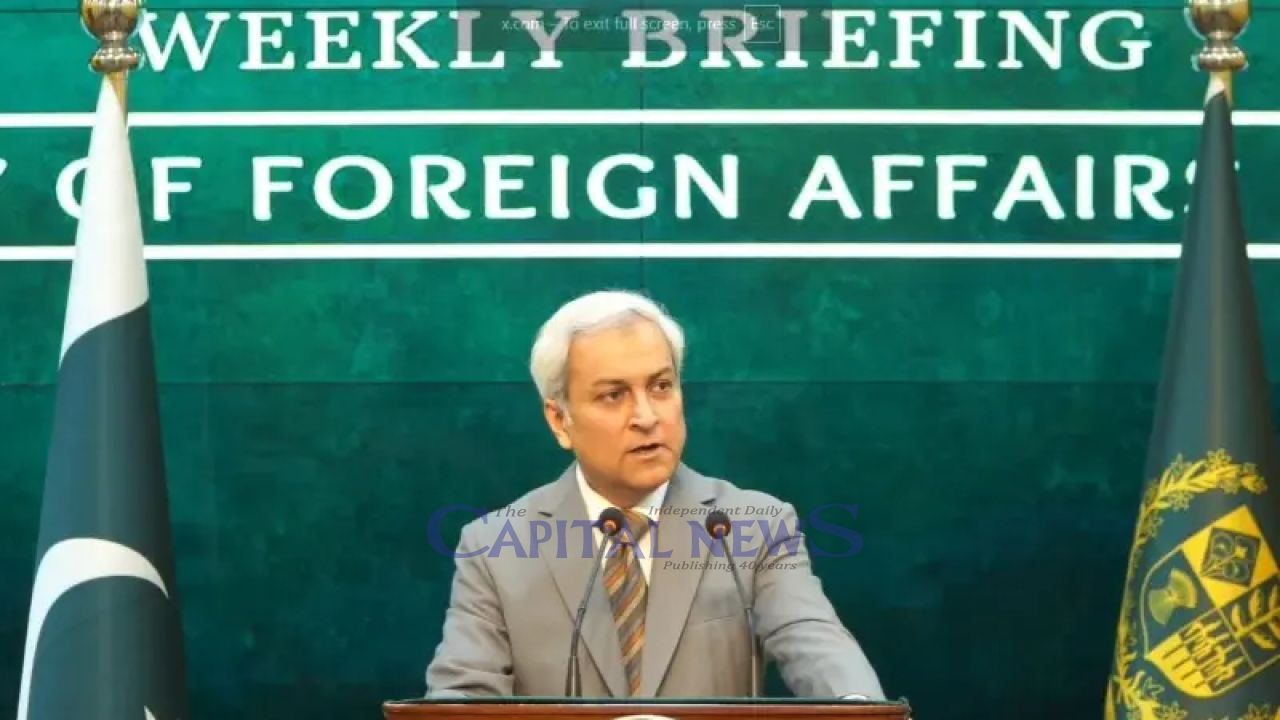
Special Correspondent: The Foreign Office Spokesperson Tahir Andrabi on Thursday termed the statement by the Indian minister on blocking water to Pakistan as “deeply irresponsible” and warned that any deliberate attempt to block water would constitute an extremely grave act with far-reaching consequences. "Any deliberate attempt to block water essential to Pakistan's survival and development would constitute an extremely grave act with far-reaching consequences. As stated at the top leadership level by Pakistan, any such act would be treated with utmost seriousness and could possibly amount to an act of war, said Andrabi during the weekly press briefing.
The
statement came after Indian Minister of Water CR Patil said India was working
to ensure "not a single drop of water" would flow into neighbouring
Pakistan. "It is certain, not a single drop of water will go (to Pakistan)
in the coming years," Patil, speaking in Hindi, said that India is
"actively working on it" after "directives" from Prime
Minister Narendra Modi. Andrabi, during today's news conference, said under Article
51 of the UN Charter, every state retained the inherent right to self-defence.
“Pakistan
will take all necessary measures to safeguard its economy and its vital
national interests and the lives of its 250 million people. We call upon India
to act responsibly, honour its international commitment and refrain from
statements and actions that could further escalate tensions in the region,” he
said. He said that Pakistan remained committed to safeguarding its interests,
as “I said, and we will closely monitor developments on the ground in Indian
illegally occupied Jammu and Kashmir (IIOJK) and elsewhere from where these
water resources emerge.
Andrabi
further said that Pakistan firmly rejected any notion that water can be treated
as a political tool or instrument of coercion or a weapon. “Such actions would
threaten not just regional peace and security of South Asia and beyond, and the
responsibility of such a threat to international peace and security would fall
squarely on India's shoulders,” he stated. The spokesperson rejected any comparison
between the two sides of the Line of Control (LoC), saying Pakistan “also
rejects any insinuation of the false equivalence between the situation in IIOJK
and matters relating to AJK”.
He said
IIOJK was “an illegally annexed, internationally recognised disputed
territory,” where people had “suffered systemic abuses under draconian laws”
and had been denied their right to self-determination under UN Security Council
resolutions. By contrast, he said, “the situation in Azad Jammu and Kashmir…
[is being] addressed within a democratic and constitutional framework.” He
added, “Any attempt to conflate the two is misleading and does not withstand
objective scrutiny”.
Reiterating
Pakistan’s position, he said Islamabad would continue to support “the human rights
of Kashmiris, including their inalienable right to self-determination,” and
pursue a “peaceful resolution of these eight decades-old disputes in accordance
with international law… and the wishes and aspirations of the Kashmiri people.”
He also urged India to agree to an UN-supervised plebiscite, saying, “If India
sincerely believes that the wishes of the Kashmiri people… should prevail… it
must uphold their right to self-determination.”
সোমবার, ১৫ জুন ২০২৬
Publish Date : 11 June 2026






Write Your Opinion