

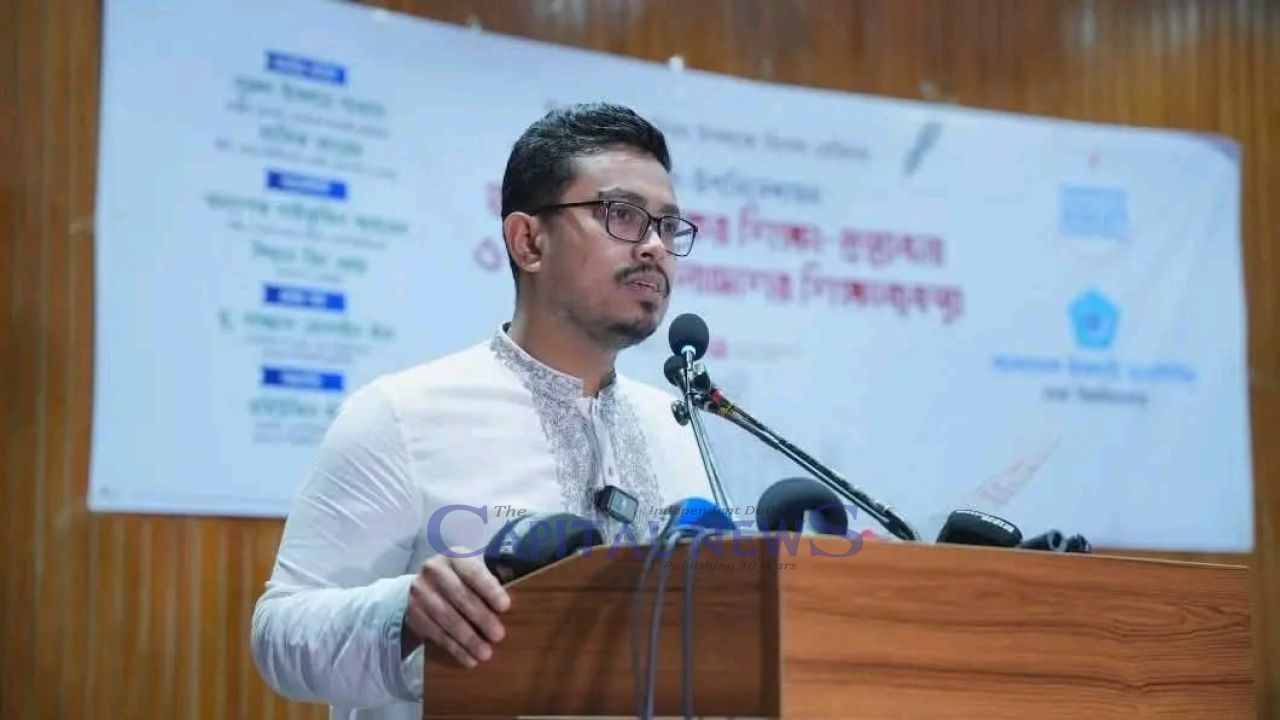
DU Correspondent: A special seminar at the University of Dhaka has brought the question of how Bangladesh should reshape its education system in light of its own history, values and social realities into renewed focus.
Bangladesh Islami Chhatra Shibir Dhaka University unit
organised a seminar titled “Decolonisation of Education: Abdul Malek’s
Education Proposals and the Present Education System of Bangladesh on the
occasion Islamic Education Day.” It was held at 3pm on Saturday at the July
Martyrs Memorial Auditorium of Mujib Hall. The discussion centred on the
structure of Bangladesh’s existing education system, the influence of colonial-era
ideas and the relevance of educationist Abdul Malek’s thinking to the country’s
contemporary educational needs.
Nurul Islam, central president of Bangladesh Islami
Chhatra Shibir, and Sadiq Kayem, VP of the Dhaka University Central Students’
Union (DUCSU) were attended among the invited guests.
The seminar featured a panel discussion involving
Saifuddin Ahmed, a professor at the University of Dhaka’s Department of Peace
and Conflict Studies, and Editor and Essayist Shihan Bin Omar. They examined a
range of issues, including the present state of education in Bangladesh, the
purpose of education and the influence of colonial thought on educational
practices and institutions.
Md Sazzad Hossain Khan, organising secretary of the
Dhaka University unit of Bangladesh Islami Chhatra Shibir was presented as the
keynote paper. His paper examined different aspects of Abdul Malek’s
educational proposals and considered their relevance to the present education
system in Bangladesh.
The organisers said the seminar sought to place the
concept of “decolonisation of education” at the centre of public discussion. In
particular, it raised the question of what philosophy and values should guide
education in Bangladesh.
The discussion also provided an opportunity to
examine both the limitations and possibilities of the country’s existing
education system.
The idea of decolonising education generally
involves critically examining inherited systems of knowledge, institutions and
educational approaches that developed under colonial rule. Supporters of the
idea argue that education should reflect a society’s own historical experience,
cultural context and intellectual priorities rather than relying uncritically
on models inherited from elsewhere.
In the Bangladeshi context, however, such a debate
also raises broader questions: What should be the ultimate purpose of
education? How should academic freedom and independent inquiry be protected?
And how can the education system remain relevant to Bangladesh’s social,
economic and national realities while engaging with global knowledge?
A central feature of the seminar was the examination
of educationist Abdul Malek’s proposals. The organisers sought to connect his
ideas with contemporary debates over the direction and purpose of education in
Bangladesh.
Rather than treating education simply as a means of
obtaining qualifications or employment, the discussion placed greater emphasis
on the philosophical foundations of education and the values that shape
learners and society.
The debate is particularly significant at a time
when questions about curriculum, educational quality, national identity,
employability, critical thinking and the relationship between education and
social values continue to generate discussion across Bangladesh.
The seminar was chaired by Mohiuddin Khan, president
of the Dhaka University unit of Bangladesh Islami Chhatra Shibir.
According to the organisers, the event has opened
another space for discussion on education, philosophy and national education
policy within the university community. At its heart were questions about the
goals of education, freedom of intellectual inquiry and the development of an
education system suited to Bangladesh’s own circumstances.
The seminar therefore adds another voice to the
continuing national conversation over what Bangladesh’s education system should
seek to achieve—and how the country can balance its own intellectual and
cultural priorities with the demands of an increasingly interconnected world.
Subject : Campus Chhatra Shibir Seminar
সোমবার, ১৯ অক্টোবর ২০২৬
Publish Date : 16 August 2026
Write Your Opinion