

Ulama call for united resistance to protect Qawmi madrasa traditions and educational autonomy
Prominent Islamic scholars have called for unity among the country’s religious scholars, madrasa teachers and administrators to protect the distinct identity, heritage and institutional rights of madrasa education, warning that reforms must not undermine its core principles and traditions.
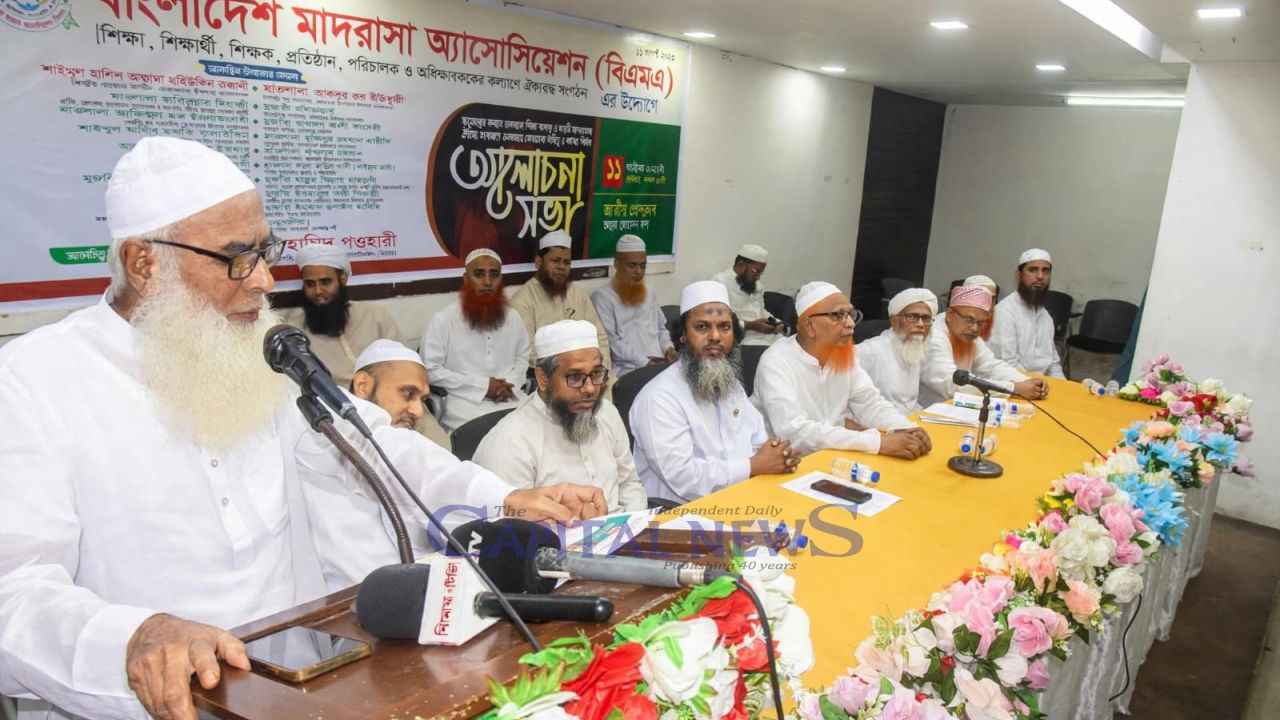
The call came at a discussion meeting titled “Madrasa Education System Under Conspiracy and the Responsibilities of Ulama in Preserving Qawmi Madrasa Traditions”, organised by the Bangladesh Madrasa Association (BMA) at the Zahir Hossain Chowdhury Hall of the National Press Club on Sunday morning.
Speakers at the meeting, which began at 10am, stressed that any initiative affecting madrasa education should be undertaken through meaningful consultation with Islamic scholars, madrasa authorities and experienced educationists.
The BMA, which brings together more than 650 madrasas, said protecting the distinctive character of religious education was a shared responsibility requiring collective efforts from scholars, teachers, students, guardians and concerned citizens.
The speakers observed that madrasa education is an integral part of Bangladesh’s religious, moral and social heritage. They called for a principled, evidence-based and united response to any measure that could compromise its independent curriculum, institutional dignity or legitimate rights.
They also acknowledged the need to improve educational standards, develop contemporary skills and strengthen institutions. However, they maintained that such improvements should not come at the expense of religious education’s fundamental values, the traditions of Qawmi madrasas or the rightful position of Islamic scholars.
Addressing the meeting as the chief guest, eminent Islamic scholar and Shaikhul Hadith Allama Mohiuddin Rabbani said madrasa education was more than an educational system, describing it as a bearer of the Muslim community’s faith, religious heritage and moral values.
He urged Islamic scholars to set aside their differences and unite to safeguard the identity of madrasa education.
“Any injustice, discrimination or unreasonable interference against madrasa education must be met with peaceful, organised and firm protest,” he said.
Rabbani also called for improving the quality of education without compromising the dignity of religious learning and for ensuring that Islamic knowledge and traditions were passed on to future generations.
He emphasised that preserving the distinctive character of madrasa education and improving its standards should go hand in hand.
BMA President Mufti Abdul Hamid Gawhari, who chaired the meeting, said the association would not compromise on protecting the dignity of madrasa education and Qawmi traditions.
“Our protest must be based on reason, discipline and peace. Unity, not division, is our strength,” he said.
He urged all concerned to work together to establish the legitimate rights of madrasas and preserve the distinctive character of religious education.
Gawhari called for avoiding discriminatory measures against madrasas, ensuring respect for Islamic scholars and pursuing educational reforms through dialogue and consultation among all stakeholders.
He also appealed to madrasa teachers, students, guardians and religiously minded citizens across the country to remain united in protecting the interests of religious education.
BMA founder and organising secretary Mufti Hifzur Rahman said the association’s initiative, bringing together more than 650 madrasas, represented a collective effort to defend the rights and traditions of madrasa education.
He said attempts to undervalue madrasa education, restrict its distinctive character or impose decisions without consulting Islamic scholars would be unacceptable.
“Silence is not the answer when it comes to madrasa education. Awareness, organisation and united protest are necessary,” he said.
Rahman said the BMA would continue working to raise the legitimate demands of madrasa teachers, students, management committees and Islamic scholars.
He urged the relevant authorities to ensure meaningful consultation with scholars before taking policy decisions affecting the future of madrasa education.
Other speakers warned that confusion, discrimination and unnecessary interference could create concerns among madrasa communities and called for a constructive approach to resolving any disagreements over educational policy.
They said the views and experience of those directly involved in madrasa education should receive due consideration in decisions concerning curricula, institutional management and future development.
The meeting was attended by several Islamic scholars and religious leaders, including Maulana Habibullah Miazi, Mufti Bashirullah, Maulana Azizul Haque Islamabadi, Mufti Ahmad Ali Qasemi, Maulana Mujibur Rahman Hamidi, Shaikhul Hadith Mufti Salahuddin, Maulana Fazlur Rahman, Mufti Shamsuddin Qasemi, Mohammad Raj, a convert to Islam, Mufti Nazirul Islam, Mufti Rafiqul Islam Nurani, Mufti Mahmudul Haque Hafezzi, Mufti Omar Faruk Siraji, Mufti Mozammel Haque, Maulana Rais Uddin, Mufti Ahsan Habib, Maulana Mobasher Hossain, Maulana Abir Mohammad Rowshan and Maulana Mostafa Kaiser, among others.
In its concluding appeal, the BMA said preserving the dignity of madrasa education and the heritage of Qawmi institutions was not the responsibility of any single individual or organisation but a collective national responsibility.
The association called on Islamic scholars, teachers, students, guardians and other stakeholders to work together against any initiative that could lead to discrimination or undermine the distinctive character of madrasa education.
The speakers’ central message was that educational development and the preservation of religious identity need not be contradictory. Rather, they said, reforms should be pursued through dialogue, mutual respect and the active participation of those whose institutions and traditions are directly affected.
The meeting ended with a renewed call for unity, peaceful engagement and collective action to safeguard madrasa education while ensuring its continued development for future generations.
Subject : Madrasa Education
সোমবার, ১৯ অক্টোবর ২০২৬
Publish Date : 11 October 2026
Write Your Opinion