

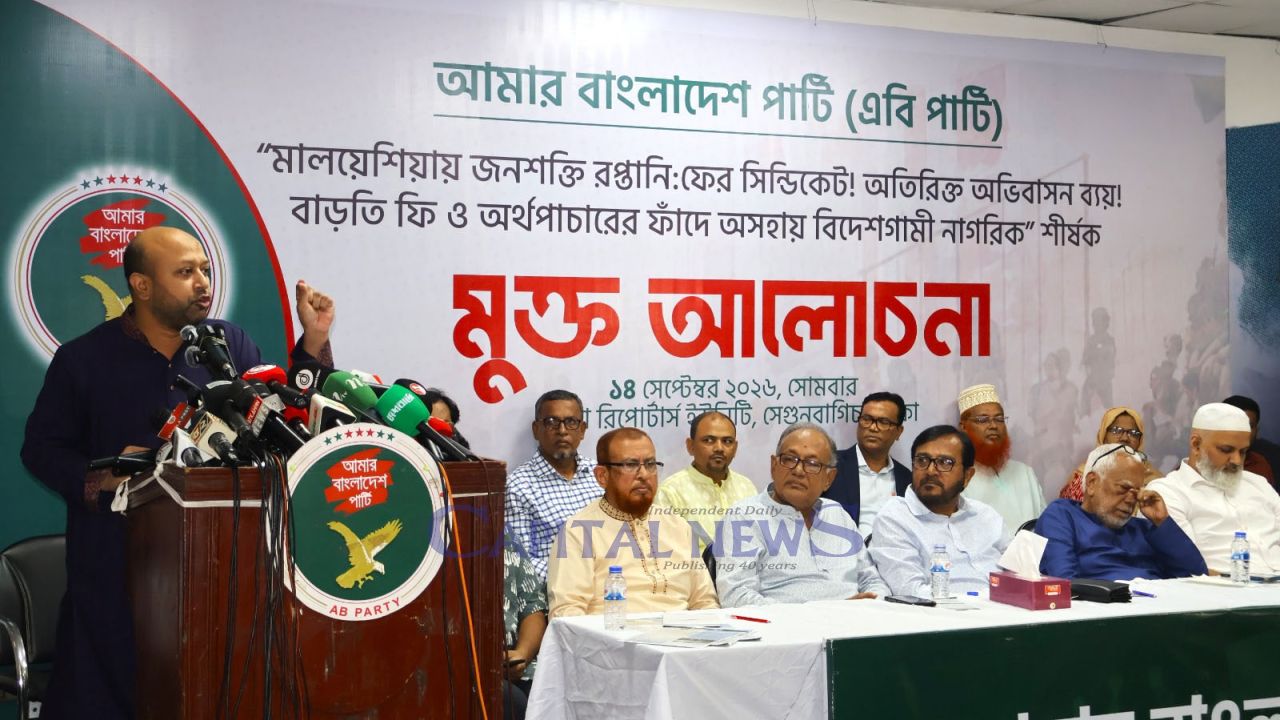
MM Rahmatullah: Amar Bangladesh Party-AB Party has called for an end to the alleged syndicate system in recruiting Bangladeshi workers for Malaysia, demanding that all valid and licensed recruiting agencies be allowed to operate through a transparent and open competitive process.
The party also demanded that workers
not be charged any amount beyond the migration costs fixed by the government
and that the overall cost of going to Malaysia be reduced.
The demands were made at a
discussion titled “Manpower Export to Malaysia: Syndicate, Prospects and the
Way Forward” held at the Shafiqul Kabir Auditorium of Dhaka Reporters Unity
(DRU) on Monday.
The speakers alleged that although
the composition of the syndicate may have changed, the underlying structure
remains largely unchanged.
AB Party Chairman Majibur Rahman
Manju chaired the discussion, moderated by the party’s Shadow Government
Affairs Coordinator Barrister Abbas Islam Khan Noman.
Speaking at the event, Manju
questioned why recruiting agencies should be granted licences after extensive
government scrutiny if they are subsequently denied opportunities to send
workers abroad.
“After such scrutiny, if licensed
agencies cannot work, what is the purpose of issuing licences?” he asked.
He called for all licensed agencies
to be given equal opportunities under a transparent and open competitive system
and stressed that no money should be collected from workers beyond the
government-fixed migration costs.
Referring to the long-running
controversy over syndicates in sending Bangladeshi workers to Malaysia, Manju
said the country must move away from a syndicate-dependent system and establish
a competitive environment that protects workers’ interests.
He also urged prospective migrant
workers to be cautious and verify all relevant information before deciding to
go abroad. Many recruiting agencies have already started conducting interviews,
he said, adding that Malaysia remains an extremely important labour market for
Bangladesh.
BNP Vice Chairman Dr Asaduzzaman
Ripon said expatriate Bangladeshis played an important role in the August 5
movement, including by participating in the movement and withholding
remittances as part of the anti-fascist struggle.
He said Bangladeshi workers earn
foreign currency for the country through hard work overseas, while wealthy
families often take money out of the country when their children go abroad for
education.
He urged recruiting agencies to give
the highest priority to workers’ interests and safety, and expressed
determination to build a syndicate-free Bangladesh in line with the aspirations
of August 5.
Investment Corporation of Bangladesh
(ICB) Chairman Professor Dr Abu Ahmed said restricting manpower exports to a
specific group of 25 companies should be avoided.
Opening the process to wider competition,
he said, would increase competition among agencies and reduce the cost of
migration for workers.
He also called for measures to
ensure that workers can go abroad through an easy, transparent and affordable
process.
AB Party Secretary General Barrister
Asaduzzaman Fuad said migrant workers endure severe hardship for relatively low
incomes, yet in many cases they do not receive even minimum humane treatment
from the relevant authorities.
“Migrant workers must not be treated
as commodities,” he said, stressing that simply calling them “remittance
warriors” is not enough. Their rights, security and dignity must also be
ensured.
Fuad also demanded an explanation
from the Prime Minister’s Office regarding reports of a meeting between the
Prime Minister and Datu Amin. He said no attempt to manipulate the interests of
expatriate workers would be accepted.
He further demanded the immediate
cancellation of the 25-company syndicate and called for a low-cost, transparent
and accountable system for sending workers abroad.
Barrister Dr Najibur Rahman Momen,
MP from Pabna-1 constituency said, many Bangladeshi workers sell land to
finance their migration and then endure inhumane working conditions to send
money home. He alleged that an old syndicate had once again become active in
sending workers to Malaysia and questioned how 17 companies with no relevant
experience could be included in the process. “If Nepal and the Philippines can
stand firmly for their national interests, why can’t Bangladesh?” he asked.
Former BAIRA Joint Secretary General
Fakhrul Islam said Malaysia is a vital labour market for Bangladesh, but it was
disappointing that what he described as a syndicate established during the
Awami League period was still in place.
He alleged that the interim
government had failed to make visible progress in reopening and managing the
Malaysian labour market and that, instead of dismantling the syndicate, the
current policy could create opportunities for it to become stronger.
Former BAIRA Joint Secretary General
Nurul Islam expressed hope that the Prime Minister, as the son of Shaheed Ziaur
Rahman, would intervene directly in the issue and dismantle the previous
syndicate in the Malaysian labour market.
Journalist Rajib Ahmed spoke about
the Malaysian labour market, alleged syndicate activities in the media and the
role of journalists in protecting the interests of migrant workers.
In his welcome speech, AB Party Vice
Chairman Professor Dr Abdul Wahab Minar said people migrate from one country to
another in search of livelihoods. Although Malaysia has created an opportunity
to recruit workers from Bangladesh, there are concerns that the old syndicate
could become active again.
He stressed the need for a
transparent, accountable and humane migration system that prioritises the
interests of workers.
A number of AB Party leaders and
activists attended the discussion.
সোমবার, ১৯ অক্টোবর ২০২৬
Publish Date : 14 September 2026





Write Your Opinion