

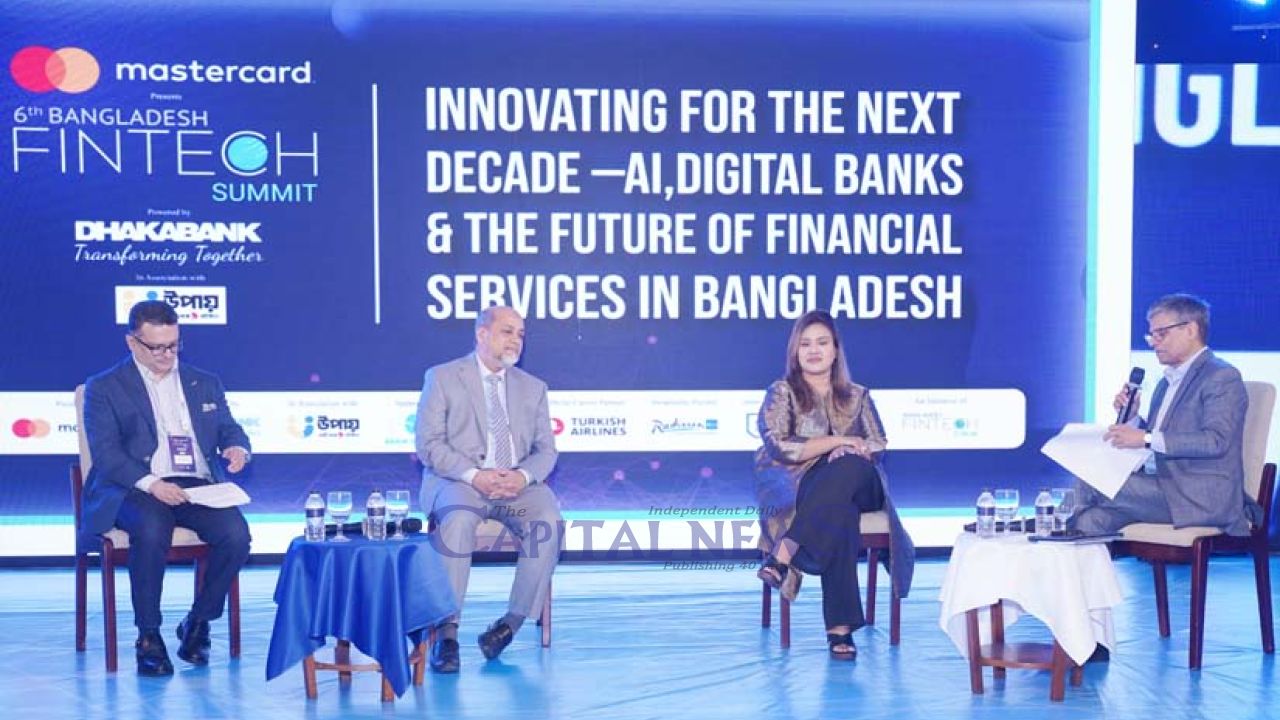
Special Correspondent: Bangladesh’s financial technology sector is entering a new phase of development, with industry leaders calling for stronger digital infrastructure, wider financial inclusion, enhanced customer protection and responsible adoption of artificial intelligence (AI) to build a more accessible and trusted financial system.
These
priorities emerged at the Mastercard Presents 6th Bangladesh Fintech Summit,
held at Radisson Blu Water Garden Hotel in Dhaka on Saturday. The day-long
event brought together banking and fintech executives, investors, regulators,
technology specialists, startup founders and academics to discuss the
opportunities and challenges shaping the country’s digital financial
transformation.
Initiated
by Bangladesh Fintech Forum and organised by Bangladesh Brand Forum, the summit
highlighted the need to move beyond basic digital adoption towards reliable,
secure and customer-focused financial services that can support Bangladesh’s
evolving economy.
As
digital payments, mobile financial services and technology-driven banking
continue to reshape the financial landscape, participants discussed how
innovation could make transactions easier, extend services to underserved
communities and strengthen confidence in digital finance.
Welcoming
participants, Sajid Mahbub, Group Chief Executive Officer and Executive Editor
of Bangladesh Brand Forum, said the next phase of the country’s fintech journey
would depend on translating digital adoption into lasting financial
capabilities.
He
stressed that innovation should make financial services more accessible and
useful while reinforcing public trust, requiring coordinated efforts among
financial institutions, entrepreneurs and policymakers.
The
summit featured two keynote sessions, three panel discussions, an expert deep
dive, an insight session and a case study, covering regional banking trends,
digital bank development, AI-driven services and the regulatory foundations of
financial innovation.
Keynote
speakers Naushad Hussain, a former senior banking and payments executive with
experience at CIMB Group and other financial technology organisations, and
Khuan Yew Lee, Executive Director and Regional Head of Product at GXBank, GXS
Bank and Grab, shared perspectives on the changing banking landscape across
ASEAN and South Asia.
Their
sessions examined the convergence of banking services across regional markets
and the journey of building a digital bank from its inception to one million
customers.
The
discussions highlighted the importance of customer-focused product development,
reliable technology and consumer confidence in expanding digital financial
services.
For
Bangladesh, the experiences of regional markets offer potential lessons in developing
innovative banking products, improving service delivery and reaching customers
who remain underserved by traditional financial institutions.
Artificial
intelligence featured prominently in discussions about the future of banking
and financial services.
Gazi
Yar Mohammed, Co-founder and CEO of Kube Money, Co-founder of Dana Fintech and
former Executive Vice-President and Head of Digital Financial Services at One
Bank Limited, led an expert session on the shift from automation to agentic
intelligence.
The
session explored how increasingly autonomous AI systems could influence the
operations of banks and fintech companies, including their potential to
streamline processes and support more responsive financial services.
However,
the discussions also underscored the importance of appropriate governance, data
protection and consumer safeguards as financial institutions adopt more
advanced technologies.
For
Bangladesh, the challenge will be to harness AI’s potential while ensuring that
technological progress does not undermine transparency, accountability or
customer confidence.
Another
major focus was the role of cashless transactions, digital banks and
interoperable payment systems in expanding access to financial services.
Speakers
discussed how improved interoperability—the ability of different financial
platforms and payment systems to work together—could help extend digital
transactions to the next 100 million people.
A
more connected payment ecosystem could make it easier for individuals and
businesses to transfer money across platforms, potentially reducing transaction
barriers and improving convenience.
Such
developments could be particularly significant for small businesses, rural
communities and people with limited access to conventional banking services.
Participants
also examined the need for secure and scalable financial infrastructure capable
of supporting the growing volume and complexity of digital transactions.
The
summit addressed regulatory sandboxes, AI governance, data protection and
consumer protection as essential elements of a sustainable fintech ecosystem.
Regulatory
sandboxes allow financial technology companies to test innovative products and
services within a controlled regulatory environment. Such arrangements can help
regulators understand emerging technologies while enabling businesses to develop
new solutions responsibly.
Speakers
also considered how appropriate safeguards could encourage innovation without
exposing customers to unnecessary financial, technological or privacy risks.
Building
consumer confidence will remain critical as more people use digital platforms
for payments, savings, banking and other financial activities. Reliable
services, transparent practices and effective protection against fraud and
misuse of personal data are central to that effort.
The
summit brought together prominent representatives from banking, payments, insurance,
technology and academia.
Among
the speakers were Osman Ershad Faiz, Managing Director and CEO of Dhaka Bank
PLC; Mohammad Ali, Managing Director and CEO of Pubali Bank PLC; Syed Mahbubur
Rahman, Managing Director and CEO of Mutual Trust Bank PLC; and Farzanah
Chowdhury, Managing Director and CEO of Green Delta Insurance PLC.
Other
participants included Ali Reza Iftekhar, adviser to Bank Asia PLC and former
Managing Director and CEO of Eastern Bank PLC; Shyamol B. Das, Managing
Director and CEO of UCB Fintech Company Ltd. (upay); Zakia Sultana Laboni,
Country Manager of Mastercard Bangladesh; and Yousup Faruqu, CEO of Raptas and
former Managing Director of Microsoft Bangladesh, Bhutan and Nepal.
Professor
Imran Rahman, Dean of Business and Policy Adviser at Independent University,
Bangladesh, and a board member of BRAC University, also contributed to the
discussions.
Their
participation brought together perspectives from financial institutions, payment
networks, insurance providers, technology companies and academia on the
practical requirements for advancing Bangladesh’s digital financial ecosystem.
The
summit was held at a time when digital transformation is becoming increasingly
important to the competitiveness of financial institutions and the wider
economy. For Bangladesh, the potential benefits extend beyond faster payments
to include more efficient business transactions, improved access to financial
services and greater opportunities for technology-driven entrepreneurship.
Realising
these benefits, however, will require investment in infrastructure, skilled
professionals, cybersecurity, effective regulation and services designed around
customers’ needs.
The
discussions at the sixth Bangladesh Fintech Summit reinforced the importance of
cooperation among banks, fintech companies, regulators and technology providers
in creating a system that is both innovative and dependable.
The
summit was initiated by Bangladesh Fintech Forum and organised by Bangladesh
Brand Forum, with Mastercard as presenting partner, Dhaka Bank PLC as
powered-by partner and upay as an associate partner.
Brain
Station 23 supported the event, Bangladesh Innovation Conclave served as
innovation partner, Turkish Airlines as official carrier partner, Radisson Blu
Water Garden Hotel, Dhaka as hospitality partner, and Backpage PR as public
relations partner.
As
Bangladesh advances towards a more digitally connected economy, the sector’s
next challenge will be to ensure that technological innovation translates into
practical benefits for citizens and businesses while maintaining the security,
trust and resilience needed for long-term growth.
Subject : Corporate
শুক্রবার, ২৩ অক্টোবর ২০২৬
Publish Date : 10 October 2026








Write Your Opinion