The Daily Capital News

Australia urged to explore commercial partnerships with Bangladesh on clean energy transition

Australia urged to explore commercial partnerships with Bangladesh on clean energy transition

By Imtiaz Ahmed and Samia Tabassum

Australian entrepreneurs should mull over exploring commercial partnerships with Bangladeshi businessmen on clean energy transition, a powerful catalyst in the economic development…

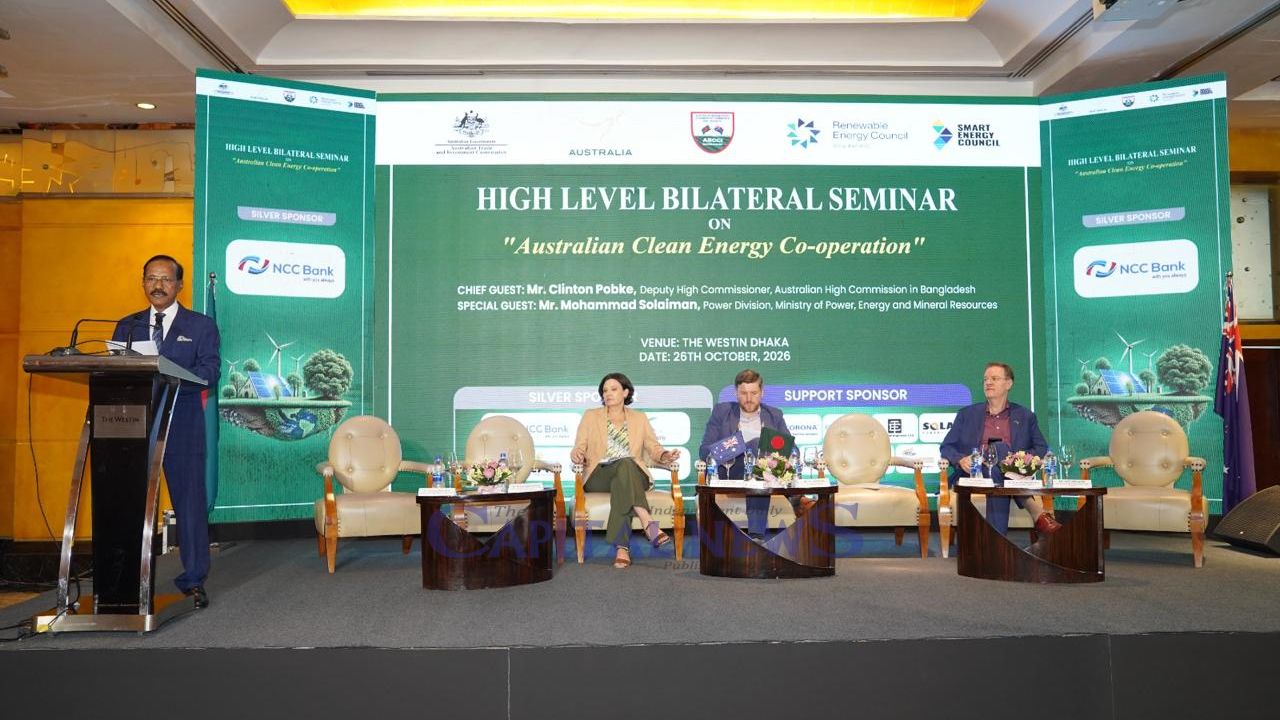
President of the Australia Bangladesh Chamber of Commerce and Industry M Maksud (ABCCI) said this at a high-level bilateral seminar on clean energy cooperation co-organized by ABCCI and the Australian High Commission at a city hotel on Monday.

The clean energy transition creates high-skilled employment, fosters technological innovation, and opens sophisticated channels for international investment, President of the Australia Bangladesh Chamber of Commerce and Industry said.

Deputy High Commissioner of Australia to Bangladesh Clinton Pobke was present as the chief guest while, Deputy Secretary, Power Division of the Ministry of Power, energy, Mineral resources, Dr. Mohammad Solaiman, was present as the special guest. 

M Maksud said “Our today's gathering transcends a routine exchange on green energy; it marks a strategic milestone in bilateral economic relationship. We assemble here to align our vision, synergize our strengths, and jointly address one of the defining imperatives of our era: advancing a secure, resilient, and sustainable energy transition.”

He also extended a warm welcome to the delegation of Australian renewable energy pioneers and officials who have traveled to Dhaka.” Your presence underscores Australia's enduring commitment to Bangladesh and highlight the intense potential for high value commercial and technological collaboration between our two friendly countries,” he said.

M Maksud also said” As one of the world's fastest-growing economies, Bangladesh's industrial expansion and urban growth demand a robust, reliable, and modern energy infrastructure. Bangladesh is actively pursuing energy security while advancing decarbonization, enhancing efficiency, and reducing reliance on fossil fuels.

The ABCCI president also said “Our vision extends beyond simply scaling generation capacity; we are focused on optimizing energy efficiency, integrating smart grid infrastructure, and securing long-term grid stability. Achieving these ambitions requires international collaboration rooted in technology transfer, institutional knowledge sharing, and capital deployment.”

He also mentioned that Australia's global leadership across the clean energy value chain-ranging from utility-scale solar and advanced battery energy storage systems to grid modernization, green hydrogen research, and electric mobility architecture is well established.

Concurrently, Bangladesh presents a dynamic market by robust manufacturing strength, growing industrial power demand, and a clear strategic orientation toward clean energy adoption.

M Maksud said “Our bilateral focus must evolve beyond conventional trade. We must forge deep institutional partnerships, encourage joint ventures, and facilitate seamless co-investment and technology co-development.”

He also said “While solar power remains a core pillar of our energy strategy, our focus is expanding into commercial and industrial rooftop applications, floating solar, and utility-scale solar integrated with storage systems. Australian expertise combined with local operational excellence creates an exceptional framework for project delivery.”


“As we integrate greater renewable capacity into our national grid, advanced storage technologies are essential intermittency and maintain frequency control. Collaborative opportunities in Battery Energy Storage Systems, micro-grids, distributed energy systems, and intelligent peak-load management represent priority avenues for collaboration, he said 

The transition toward electric mobility requires an integrated ecosystem. Bangladesh seeks to establish comprehensive infrastructure encompassing smart charging networks, battery management systems, and localized assembly, M Maksud said. 

He also said “Australian capabilities in EV technology offer a valuable roadmap for this. ABCCI advocates for a fundamental shift: viewing Bangladesh not merely as a destination for technology exports, but as an attractive hub for direct foreign investment, joint manufacturing, and long-term joint ventures.”

He also encouraged Australian firms to explore structural partnerships in joint manufacturing and assembly of clean technologies; rngineering, procurement, and technical consultancy services; research, development, and capacity building; and innovative green finance models.

The seminar brought together Australian government representatives, renewable energy companies, Bangladeshi policymakers, business leaders and financial institutions to explore potential areas for bilateral commercial cooperation.


Australian Deputy High Commissioner Clinton Pobke said Bangladesh had made significant progress in expanding electricity access and developing infrastructure to support  economic growth, but meeting rising energy demand in a secure, affordable and sustainable manner remained a major challenge.

He welcomed Bangladesh’s Renewable Energy Policy 2025, which sets targets of generating 20 percent of electricity from renewable sources by 2030 and 40 percent by 2041.

However, renewable energy accounts for around five percent of Bangladesh’s total installed power generation capacity, indicating considerable scope for investment and technological cooperation, he said.

Pobke identified rooftop solar, net metering, battery storage, grid-scale energy storage, electric vehicle charging infrastructure and floating solar as promising areas for Australian companies seeking opportunities in Bangladesh.

He also pointed to the potential for installing solar panels on underused land within tea plantations, opening another avenue for expanding renewable energy generation.

Australia has gained considerable experience in managing its energy transition, including grid integration, system security, investment and workforce development, he said.

Pobke stressed that Australian expertise would be most effective when adapted to Bangladesh’s local conditions and development priorities.

“The real opportunity is to combine international experience and technology with Bangladesh’s local knowledge, its capabilities, and its priorities,” he said.

Jody McKay, senior trade and investment commissioner at the Australian Trade and Investment Commission (Austrade), said the global energy transition was creating significant opportunities for international business, with solar power and biomass offering particular potential for cooperation with Bangladesh.

She said the Australian delegation was visiting Bangladesh not merely to showcase technologies but also to understand the local market, identify potential business partners and explore commercial opportunities.

The participating Australian companies brought expertise in solar photovoltaic systems, battery technologies, engineering, electrical safety, energy modelling, skills development and renewable energy project development.

For Australia, the potential partnership extends beyond exporting equipment to establishing a stronger commercial presence in Bangladesh through joint ventures, local manufacturing and assembly, engineering services and research collaboration.

Subject : Energy

Write Your Opinion

The Daily Capital News

মঙ্গলবার, ২৭ অক্টোবর ২০২৬


Australia urged to explore commercial partnerships with Bangladesh on clean energy transition

Publish Date : 27 October 2026

featured Image
By Imtiaz Ahmed and Samia TabassumAustralian entrepreneurs should mull over exploring commercial partnerships with Bangladeshi businessmen on clean energy transition, a powerful catalyst in the economic development…President of the Australia Bangladesh Chamber of Commerce and Industry M Maksud (ABCCI) said this at a high-level bilateral seminar on clean energy cooperation co-organized by ABCCI and the Australian High Commission at a city hotel on Monday.The clean energy transition creates high-skilled employment, fosters technological innovation, and opens sophisticated channels for international investment, President of the Australia Bangladesh Chamber of Commerce and Industry said.Deputy High Commissioner of Australia to Bangladesh Clinton Pobke was present as the chief guest while, Deputy Secretary, Power Division of the Ministry of Power, energy, Mineral resources, Dr. Mohammad Solaiman, was present as the special guest. M Maksud said “Our today's gathering transcends a routine exchange on green energy; it marks a strategic milestone in bilateral economic relationship. We assemble here to align our vision, synergize our strengths, and jointly address one of the defining imperatives of our era: advancing a secure, resilient, and sustainable energy transition.”He also extended a warm welcome to the delegation of Australian renewable energy pioneers and officials who have traveled to Dhaka.” Your presence underscores Australia's enduring commitment to Bangladesh and highlight the intense potential for high value commercial and technological collaboration between our two friendly countries,” he said.M Maksud also said” As one of the world's fastest-growing economies, Bangladesh's industrial expansion and urban growth demand a robust, reliable, and modern energy infrastructure. Bangladesh is actively pursuing energy security while advancing decarbonization, enhancing efficiency, and reducing reliance on fossil fuels.The ABCCI president also said “Our vision extends beyond simply scaling generation capacity; we are focused on optimizing energy efficiency, integrating smart grid infrastructure, and securing long-term grid stability. Achieving these ambitions requires international collaboration rooted in technology transfer, institutional knowledge sharing, and capital deployment.”He also mentioned that Australia's global leadership across the clean energy value chain-ranging from utility-scale solar and advanced battery energy storage systems to grid modernization, green hydrogen research, and electric mobility architecture is well established.Concurrently, Bangladesh presents a dynamic market by robust manufacturing strength, growing industrial power demand, and a clear strategic orientation toward clean energy adoption.M Maksud said “Our bilateral focus must evolve beyond conventional trade. We must forge deep institutional partnerships, encourage joint ventures, and facilitate seamless co-investment and technology co-development.”He also said “While solar power remains a core pillar of our energy strategy, our focus is expanding into commercial and industrial rooftop applications, floating solar, and utility-scale solar integrated with storage systems. Australian expertise combined with local operational excellence creates an exceptional framework for project delivery.”“As we integrate greater renewable capacity into our national grid, advanced storage technologies are essential intermittency and maintain frequency control. Collaborative opportunities in Battery Energy Storage Systems, micro-grids, distributed energy systems, and intelligent peak-load management represent priority avenues for collaboration, he said The transition toward electric mobility requires an integrated ecosystem. Bangladesh seeks to establish comprehensive infrastructure encompassing smart charging networks, battery management systems, and localized assembly, M Maksud said. He also said “Australian capabilities in EV technology offer a valuable roadmap for this. ABCCI advocates for a fundamental shift: viewing Bangladesh not merely as a destination for technology exports, but as an attractive hub for direct foreign investment, joint manufacturing, and long-term joint ventures.”He also encouraged Australian firms to explore structural partnerships in joint manufacturing and assembly of clean technologies; rngineering, procurement, and technical consultancy services; research, development, and capacity building; and innovative green finance models.The seminar brought together Australian government representatives, renewable energy companies, Bangladeshi policymakers, business leaders and financial institutions to explore potential areas for bilateral commercial cooperation.Australian Deputy High Commissioner Clinton Pobke said Bangladesh had made significant progress in expanding electricity access and developing infrastructure to support  economic growth, but meeting rising energy demand in a secure, affordable and sustainable manner remained a major challenge.He welcomed Bangladesh’s Renewable Energy Policy 2025, which sets targets of generating 20 percent of electricity from renewable sources by 2030 and 40 percent by 2041.However, renewable energy accounts for around five percent of Bangladesh’s total installed power generation capacity, indicating considerable scope for investment and technological cooperation, he said.Pobke identified rooftop solar, net metering, battery storage, grid-scale energy storage, electric vehicle charging infrastructure and floating solar as promising areas for Australian companies seeking opportunities in Bangladesh.He also pointed to the potential for installing solar panels on underused land within tea plantations, opening another avenue for expanding renewable energy generation.Australia has gained considerable experience in managing its energy transition, including grid integration, system security, investment and workforce development, he said.Pobke stressed that Australian expertise would be most effective when adapted to Bangladesh’s local conditions and development priorities.“The real opportunity is to combine international experience and technology with Bangladesh’s local knowledge, its capabilities, and its priorities,” he said.Jody McKay, senior trade and investment commissioner at the Australian Trade and Investment Commission (Austrade), said the global energy transition was creating significant opportunities for international business, with solar power and biomass offering particular potential for cooperation with Bangladesh.She said the Australian delegation was visiting Bangladesh not merely to showcase technologies but also to understand the local market, identify potential business partners and explore commercial opportunities.The participating Australian companies brought expertise in solar photovoltaic systems, battery technologies, engineering, electrical safety, energy modelling, skills development and renewable energy project development.For Australia, the potential partnership extends beyond exporting equipment to establishing a stronger commercial presence in Bangladesh through joint ventures, local manufacturing and assembly, engineering services and research collaboration.

The Daily Capital News

Advisory Editor: Gayeshwar Chandra Roy
Editor: Abul Kashem Majumder
Acting Editor: Mohammad Alamgir Hossain
Executive Editor: Farid Ahmed Ripon

© 2025 The Daily Capital News