

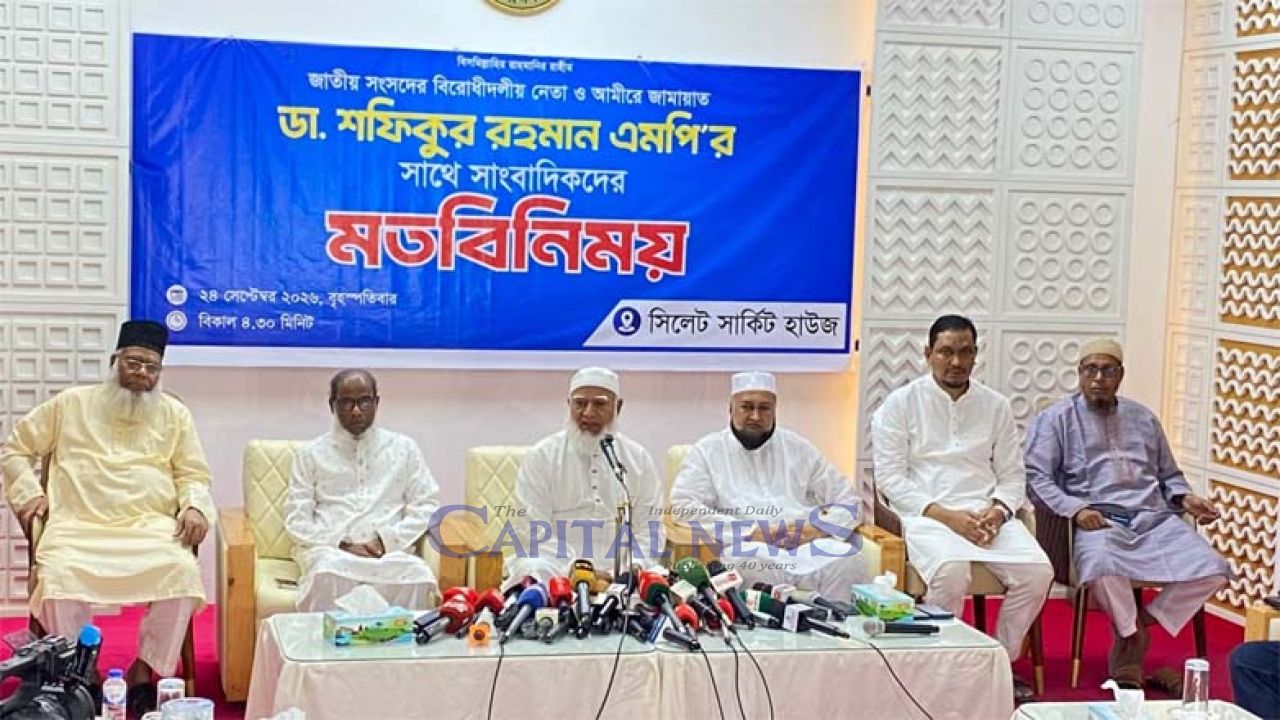
Sylhet Bureau: Bangladesh Jamaat-e-Islami Ameer and Leader of the Opposition in Parliament Dr Shafiqure Rahman has alleged that the government forced the opposition to take to the streets after failing to resolve political issues in Parliament.
“We wanted a solution in Parliament based on the
public mandate expressed through the referendum, but the government itself has
forced us onto the streets,” he said.
Dr
Rahman made the remarks while exchanging views with journalists working in
Sylhet at the Circuit House on Thursday evening.
He said
opposition lawmakers elected by the people would not compromise on what he
described as legitimate public demands.
“Our peaceful movement will continue,” he said,
adding that the government had allegedly taken a position against the people's
verdict within just seven months.
He
further alleged that cancelling the referendum verdict amounted to making a
mockery of the nation.
Responding
to a question, the opposition leader said the government could not expect
responsible behaviour only from the opposition.
“If the government expects responsible behaviour from
the opposition, can’t the nation expect responsible behaviour from the
government as well?” he asked.
He said
the government could not avoid responsibility for prolonging what he described
as the country's political crisis.
Dr
Rahman criticised what he described as contradictory statements by government
ministers on several issues, including power and energy.
“Different ministers are making different statements
on the same issues, confusing the people,” he said.
He also
questioned the government's position on local elections. While the Election
Commission is described as independent, he said, government representatives
were simultaneously announcing election-related timelines.
“The government needs to come out of this situation.
It must take a decision and clearly inform the nation,” he said.
On the
Dhaka-Sylhet highway, Dr Rahman pointed to differing statements from ministers
about the completion date of the project, with some mentioning 2028 and others
2029.
“Only the government can say which one is correct. We
can only put pressure or make recommendations,” he said.
Responding
to a question about the commerce minister's reported statement that higher fuel
prices would not affect commodity prices, the Jamaat chief said people could
already see the impact.
Transport
fares have increased and commodity prices have also started rising, he said.
“What is the guarantee that the situation will not
worsen further?” he asked, urging ministers to make more responsible
statements.
He also
criticised the government's handling of the power and energy crisis, saying
Jamaat's expert team had submitted several proposals to help address the situation,
but the government had not given them due importance.
At the
same time, he alleged, the government was seeking suggestions from the
opposition and attempting to shift responsibility onto it.
Dr
Rahman also rejected what he described as attempts by some government leaders
to create controversy over vehicles used by the opposition during a long march.
He said
the opposition had hired the vehicles by paying appropriate fares and alleged
that such controversies were being raised to create confusion among the public
about the opposition's movement.
During
the interaction, Dr Rahman also responded to questions concerning transparency
in donations to the shrine of Hazrat Shahjalal (RA), Sylhet Medical University,
the measles situation and the Rohingya crisis.
Regarding
donations to the Shahjalal shrine, he called for reconsideration of the current
committee's approach to managing the funds, citing the example of Pagla Mosque
in Kishoreganj.
He said
initiatives to use shrine donations for social welfare and the promotion of
religious activities could benefit people and encourage greater public
participation in donations.
On
Sylhet Medical University, Dr Rahman said the institution existed largely in
name and called for steps to launch its infrastructure and academic activities.
He also
expressed concern over what he described as inadequate initiatives by the
Health Ministry to prevent measles infections and deaths.
On the
Rohingya crisis, he called for stronger international efforts to find a
solution and stressed the importance of cooperation from India and China.
The
meeting was attended, among others, by Jamaat central executive council member
and Sylhet city unit Ameer Muhammad Fakhrul Islam; central Majlis-e-Shura
member and Sylhet district unit Ameer Maulana Nahabibur Rahman; Sylhet Press
Club President Muktabis-un-Nur; Sylhet city Jamaat Naib Ameer and mayoral
candidate for the upcoming Sylhet City Corporation election Dr Nurul Islam
Babul; city unit Secretary Mohammad Shahajan Ali; and district unit Secretary
Zainal Abedin.
Subject : Jamaat-e-Islami Leader of the Opposition
শনিবার, ২৬ সেপ্টেম্বর ২০২৬
Publish Date : 24 September 2026
Write Your Opinion