

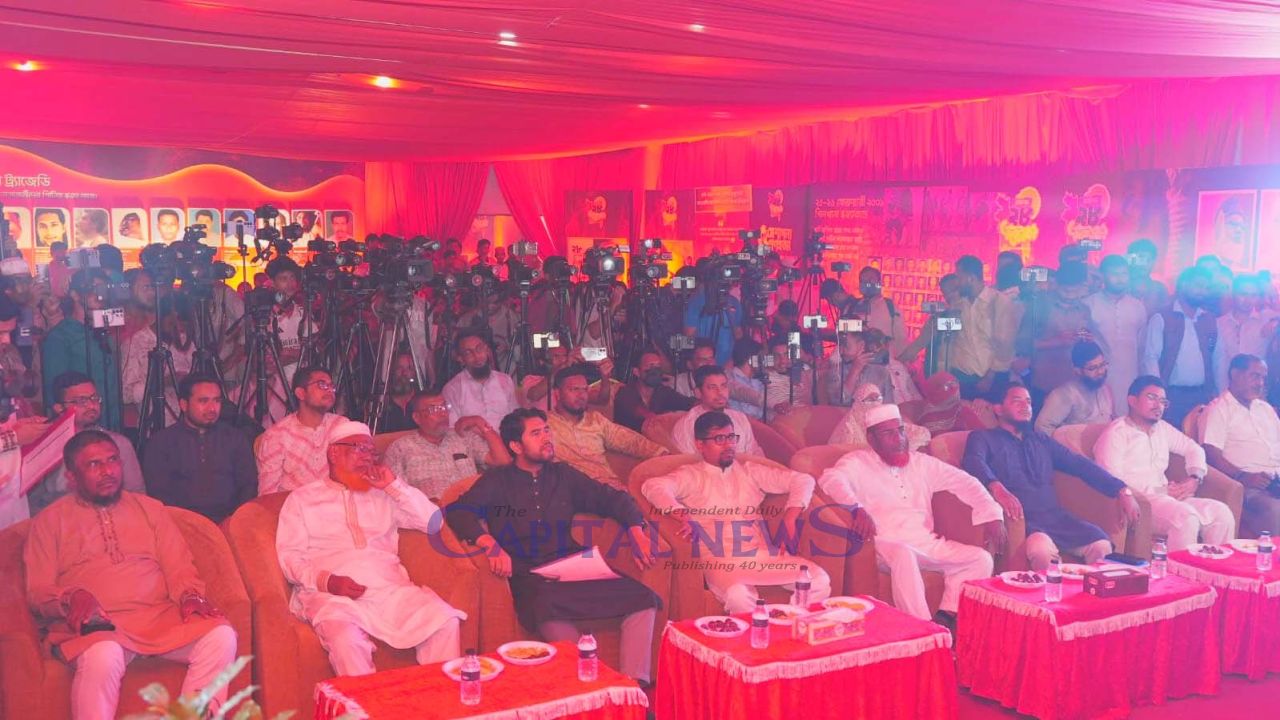
MM Rahmatullah: Bangladesh Islami Chhatra Shibir President Nurul Islam on Tuesday called for the revival of cases filed over the violence of October 28, 2006, alleging that the then Awami League government had made the cases disappear, and demanded that the trials be expedited.
He made the demand
while addressing a discussion meeting titled “October 28, 2006: Awami Brutality
and the Rise of Fascism”, organised by Chhatra Shibir’s Dhaka metropolitan
units at the Kazi Nazrul Islam Auditorium of the Dhaka Press Club.
Bangladesh Jamaat-e-Islami
Secretary General and former MP Mia Golam Parwar attended the programme as the
chief guest.
Recalling the violence
in the capital’s Paltan area in 2006, Parwar alleged that activists of the
Awami League-led 14-party alliance had attacked their opponents with firearms
and sticks. He said Chhatra Shibir activists had formed a human shield to
protect senior leaders and resist the attacks.
He described the deaths
during the incident as a turning point in the country’s political history,
alleging that the events paved the way for the rise of authoritarian rule.
Referring to the July
2024 uprising, Parwar said the movement had created an opportunity to build a
new Bangladesh based on justice and fairness. He added that the people would
continue to pursue that goal despite political opposition.
Parwar also criticised
the Awami League, alleging that its approach to democracy had been
inconsistent, with democratic rights being invoked while in opposition but
undermined during its time in power. He accused the government led by Sheikh
Hasina of presiding over a period marked by political repression, the Pilkhana
killings, the Shapla Chattar crackdown and controversial war crimes trials.
In his presidential
address, Nurul Islam questioned the progress of cases being tried by special
tribunals. He alleged that verdicts had been delivered against some accused who
were absconding, while cases involving those in custody had not been concluded.
He called for the speedy disposal and implementation of verdicts in accordance
with the law.
Islam also criticised
the current government's policies, alleging that it was restoring elements of
the old political structure instead of pursuing the institutional reforms
promised after the July uprising.
He demanded improved law
and order, structural reforms of the state and full implementation of the July
Charter. He also called on the government to respect the outcome of the
referendum, which he claimed had received the support of 70 per cent of voters.
Criticising the government's
economic measures, Islam alleged that increases in electricity bills were
placing additional pressure on households, while financial assistance through
cards was being presented as a solution. He said the government should address
people's concerns through substantive policy measures.
Special guest Dr
Shafiqul Islam Masud, a former central president of Chhatra Shibir and an MP,
described the October 28 violence as an example of extreme brutality. He
alleged that people were beaten and killed and that some bodies were subjected
to further abuse.
Addressing the
Bangladesh Nationalist Party (BNP), Masud said the previous Awami League
government had cancelled Jamaat-e-Islami's registration, restricted its
political activities and kept its offices closed. He rejected allegations of an
understanding between Jamaat and the Awami League, warning the BNP against
following what he described as the previous government's repressive political
approach.
Dr Muhammad Rezaul
Karim, a former central president of Chhatra Shibir and secretary of Jamaat's
Dhaka North city unit, said the sacrifices of those killed in political
violence would not be in vain. He expressed hope that Jamaat and Chhatra Shibir
would play a leading role in establishing a society based on justice.
Dhaka University
Central Students' Union (DUCSU) Vice-President Sadik Kayem alleged that the
October 28 violence marked the beginning of a prolonged period of political
repression. He also accused left-wing political groups of contributing to the
consolidation of authoritarian rule.
The meeting was
inaugurated by Tajul Islam, father of Hafiz Golam Kibria Shipon, who was killed
in the October 28 incident.
The programme was
jointly conducted by Dhaka metropolitan north president Saiful Islam Saim, east
president Imdadul Haque and south president Hafiz Delwar Hossain.
Other attendees
included Jamaat-e-Islami Dhaka South assistant secretary and former Chhatra
Shibir central executive council member Mohammad Kamal Hossain, MP; Chhatra
Shibir Secretary General Sibgatullah; central office secretary Azizur Rahman
Azad; leaders of the organisation's central and metropolitan units; and family
members of those killed in the October 28 violence.
The speakers'
allegations and political characterisations were made at the party-organised
event and were not independently verified in the information provided.
Subject : Chhatra Shibir October 28
বৃহস্পতিবার, ২৯ অক্টোবর ২০২৬
Publish Date : 28 October 2026

Write Your Opinion