

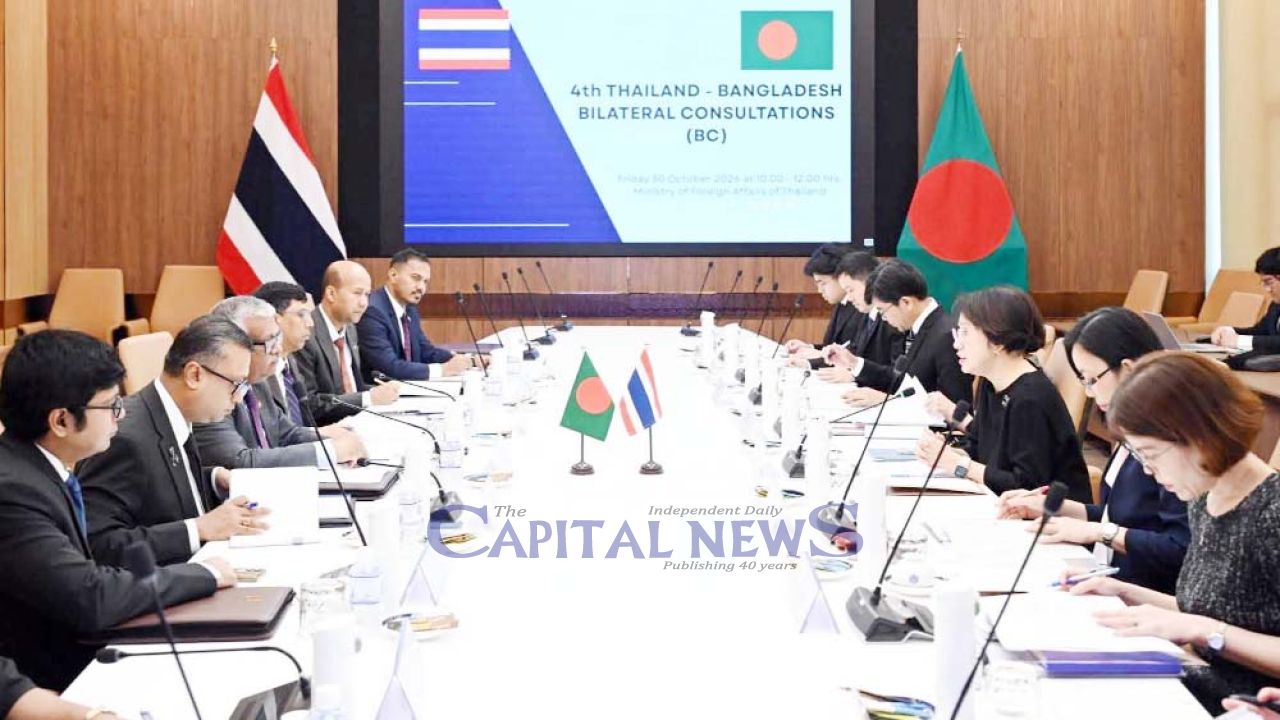
Diplomatic Correspondent: Bangladesh has urged Thailand to reduce import duties on Bangladeshi products and increase purchases of pharmaceuticals, jute and jute goods as Dhaka seeks to narrow the widening trade gap and gain a stronger foothold in the Southeast Asian market.
The proposals were
raised at the fourth Foreign Office Consultations (FOC) between Bangladesh and
Thailand, held at the Thai Ministry of Foreign Affairs on Friday, according to
a foreign ministry press release.
The move reflects
Bangladesh's growing interest in diversifying export destinations, expanding
trade with Southeast Asia and attracting Thai investment in sectors with strong
export potential.
Foreign Secretary Asad
Alam Siam led the Bangladesh delegation, while Thailand's Permanent Secretary
for Foreign Affairs Eksiri Pintaruchi headed the Thai side.
Thailand expressed
willingness to consider Bangladesh's proposals and explore opportunities to
expand bilateral trade and investment. Bangkok also called for an early start
to discussions on a bilateral free trade agreement (FTA), signalling interest
in a more structured economic partnership.
An FTA could open new
opportunities for businesses in both countries by reducing trade barriers and
improving market access. For Bangladesh, the challenge will be to secure
favourable terms for its export products as it prepares for its post-LDC
economic transition.
The consultations
covered a broad range of areas, including trade, investment, maritime
connectivity, labour migration, energy, agriculture, education, defence,
culture and climate change.
A major development in
bilateral economic cooperation has been the launch of the first direct shipping
service between Chattogram and Ranong ports in September this year.
The new maritime connection
is expected to cut transportation time from around 15 days to just four days,
significantly reducing logistics costs and making bilateral trade faster and
more competitive.
Improved shipping
connectivity could particularly benefit exporters of agricultural products,
pharmaceuticals, jute goods and other commodities requiring efficient
transportation.
Bangladesh also sought
Thai technical assistance and investment in processing locally produced fruits
and vegetables. It proposed technology transfer to help the country tap the
expanding global halal food market, which offers opportunities for value addition
and export diversification.
Under the Thailand
International Cooperation Agency (TICA) programme, Dhaka requested professional
training in hospitality, nursing, germplasm and food processing. Thailand,
meanwhile, expressed interest in sharing its experience of the 'One Village One
Product' initiative, which promotes locally produced goods and rural
entrepreneurship.
Energy cooperation also
featured prominently in the discussions. Bangladesh sought Thai expertise in
generating electricity from agricultural residues and agro-industrial waste,
reflecting its interest in diversifying renewable energy sources.
The Bangladesh
delegation highlighted the government's target of generating at least 20
percent of the country's electricity from renewable sources by 2030.
Bangladesh believes
Thailand's technological experience could help develop alternative energy
projects while creating economic value from agricultural waste.
Both sides also agreed
to consider several proposed memorandums of understanding, including agreements
on rice imports and workers' migration.
Labour migration
remains another important area of potential cooperation, with both countries
discussing ways to strengthen arrangements for workers.
On regional and
international issues, Bangladesh appreciated Thailand's continued support for
its aspiration to become an ASEAN Sectoral Dialogue Partner and join the
Regional Comprehensive Economic Partnership (RCEP).
Greater engagement with
ASEAN and RCEP could help Bangladesh expand its economic and commercial
connections with regional markets.
Dhaka also sought
Bangkok's support for the safe and sustainable repatriation of displaced
Rohingyas to their homeland in Myanmar's Rakhine State.
Both sides expressed
concern over growing cross-border criminal activities, including human and arms
trafficking, online scams and narcotics smuggling. They agreed to strengthen
cooperation and consider establishing a joint committee under their respective
home ministries to address these threats.
With Bangladesh and
Thailand set to celebrate the 55th anniversary of diplomatic relations next
year, both countries emphasised the importance of high-level political
exchanges and expressed hope that visits by their heads of government could
mark the occasion.
They also agreed to
promote cultural and sporting exchanges. Bangladesh offered to share its
cricket expertise and provide training, while Thailand proposed training
opportunities in taekwondo.
The latest
consultations underline the potential for a broader Bangladesh-Thailand
partnership extending beyond traditional diplomatic engagement.
For Bangladesh, the
immediate priority will be to translate Thailand's positive response into
practical benefits through lower tariffs, increased exports, investment, technology
transfer and improved connectivity.
The proposed FTA
discussions could become particularly significant in this regard, provided they
deliver meaningful market access for Bangladeshi businesses and help address
the existing trade imbalance.
শনিবার, ৩১ অক্টোবর ২০২৬
Publish Date : 30 October 2026




Write Your Opinion