

Tokyo pledges continued development support as Dhaka seeks to transform traditional aid ties into a mutually beneficial economic partnership
MM Rahmatullah: Bangladesh's four-day
official visit to Japan has opened up prospects for Japanese private investment
of up to 1 trillion yen, equivalent to around US$6.3 billion, over the next
five years, with the potential to generate approximately 200,000 jobs in
Bangladesh.
The visit also
reaffirmed Tokyo's commitment to continued development assistance,
infrastructure financing, technology transfer and human resource development,
marking a significant move towards transforming the longstanding bilateral
relationship into a broader economic and investment partnership.
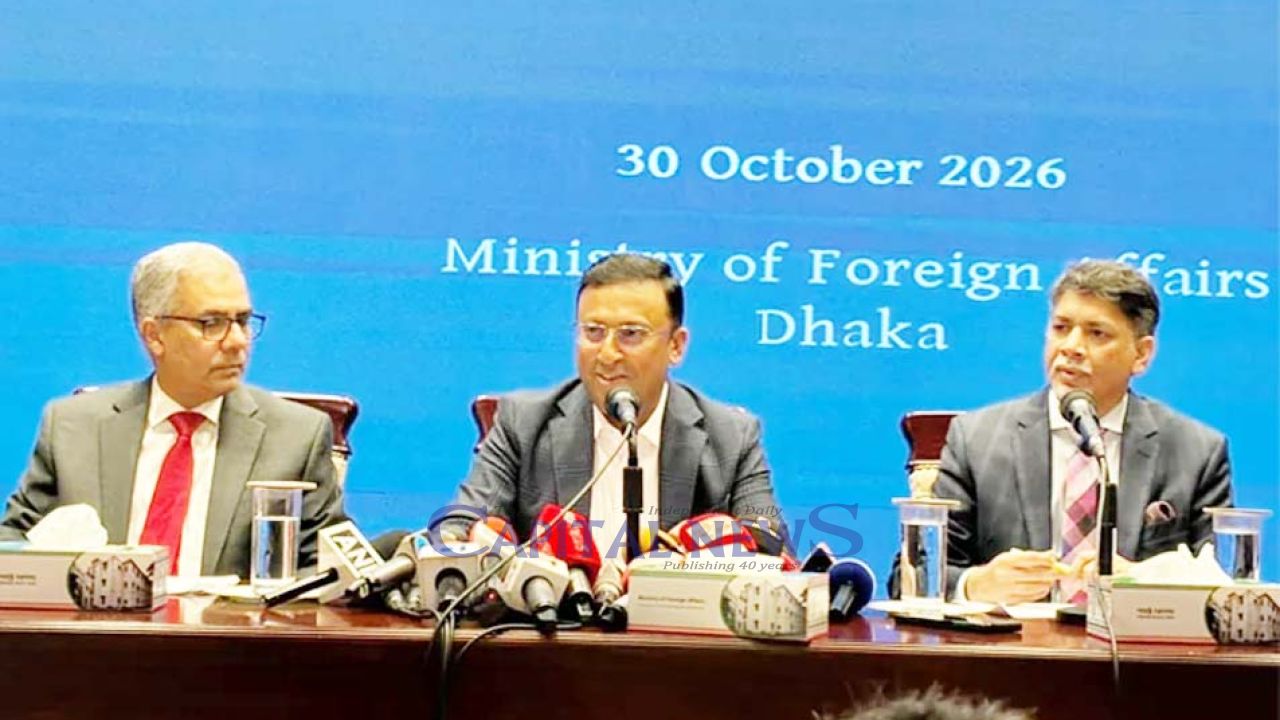
State Minister for
Foreign Affairs Humaiun Kobir disclosed the outcomes at a press conference at
the Foreign Ministry on Friday, briefing journalists on Prime Minister Tarique
Rahman's October 26-29 visit to Japan.
Describing the visit as
effective and fruitful, Kobir said the discussions had reinforced Japan's
development partnership with Bangladesh while creating new opportunities for
investment, employment, technology and industrial development.
He said the outcomes
reflected the government's 'Bangladesh First' foreign policy, which prioritises
national interests, mutual respect and stronger international economic
partnerships.
"Bangladesh will
be an investment partner. Whoever we do business with, we will do it on the
basis of an actual mutual investment partnership," the state minister
said, stressing that the country wanted to move beyond its traditional
dependence on concessional loans and development assistance.
A major outcome of the
visit was the expression of interest in mobilising up to 1 trillion yen in
Japanese private-sector investment in Bangladesh over the next five years.
According to Kobir, the
proposed investment could create around 200,000 employment opportunities,
offering a significant boost to the country's industrialisation, export growth
and job market.
He clarified that the amount represented potential private-sector investment rather than a government loan commitment.
A Japanese economic
mission is expected to visit Bangladesh soon at a mutually convenient time to
explore investment opportunities further, following consultations between the
two countries.
The government will
assess proposed investments based on national priorities, affordability,
competitiveness and employment generation, ensuring that projects deliver
tangible economic benefits.
The two countries also
agreed to upgrade their longstanding Bay of Bengal Industrial Growth Belt
(BIG-B) initiative to 'BIG-B for Shared Prosperity', reflecting a broader
vision of economic cooperation.
The upgraded framework
envisages integrated development of energy, deep-sea ports, industrial
facilities, information and communication technology infrastructure and
regional connectivity, alongside stronger public-private partnerships.
Kobir clarified that
discussions during the visit concerning the initiative focused exclusively on
bilateral economic relations between Bangladesh and Japan.
He said no third
country was discussed, adding that any future regional arrangement involving
other countries would require their participation in negotiations.
The state minister also
assured that Bangladesh would protect its national interests and maintain
transparency and accountability in international agreements.
Japan has reaffirmed
its commitment to supporting Bangladesh's major infrastructure and development
projects.
Discussions covered the
early operationalisation of the Third Terminal at Hazrat Shahjalal
International Airport, accelerated implementation of Dhaka's Mass Rapid Transit
projects and possible Japanese cooperation in the construction, operation and
management of Matarbari Deep Sea Port.
Prime Minister Rahman
also expressed gratitude for Japan's 50-billion-yen emergency support loan,
equivalent to around US$314 million, aimed at strengthening Bangladesh's
economic resilience and ensuring stable energy supplies.
During a meeting with
Japan International Cooperation Agency (JICA) President Dr Akihiko Tanaka, the
Prime Minister stressed the need for timely completion of Japanese-funded
projects and sought continued concessional financing and expanded technical
cooperation.
Kobir said Bangladesh
would compare Japan's future lending terms with other available international
financing options to ensure affordability and economic benefits.
Attracting private
investment and expanding industrial cooperation were among the key priorities
of the Prime Minister's visit.
Rahman held discussions
with leading Japanese business organisations and corporations, including Fast
Retailing, the parent company of UNIQLO, Marubeni Corporation, Mitsubishi
Corporation and Toyota Tsusho Corporation.
The discussions focused
on potential investment in Bangladesh's ready-made garment sector, renewable
energy, ICT, advanced manufacturing and infrastructure.
Technology transfer,
skills development, environmentally sustainable production and export
diversification also featured prominently.
Addressing the Japan-Bangladesh Economic Forum Dialogue, the Prime Minister invited Japanese businesses to explore Bangladesh's growing investment opportunities.
Kobir said the
government was committed to improving the business climate through greater transparency
and reforms in taxation, customs clearance, remittance procedures and
licensing.
Human resource
development and technology transfer emerged as important components of the
discussions.
The government sees
Japanese investment not merely as a source of capital but also as an
opportunity to develop skilled workers, modernise industries and improve
Bangladesh's competitiveness in international markets.
The Prime Minister's
visit to Toyota's Motomachi manufacturing facility in Nagoya on October 29 was
particularly significant in this regard.
Company officials
expressed interest in establishing manufacturing operations in Bangladesh for
automobiles and other machinery, potentially opening a new chapter in the
country's industrial diversification.
Rahman also visited
JERA's LNG terminal and power plant in Futtsu and a logistics hub in Chiba
Prefecture to gain practical knowledge about energy infrastructure and
logistics management.
Kobir clarified that
the LNG facility visit was intended to gather technical experience relevant to
Bangladesh's energy development plans, rather than negotiate LNG imports from
Japan.
During the visit,
Bangladesh and Japan signed six cooperation agreements and memorandums of
understanding covering economic relations, improvement of the business
environment, agriculture, fisheries and livestock, coastal security, climate
cooperation and information technology.
Arrangements relating
to investment facilitation and local government development were also
finalised.
The two countries
reaffirmed their commitment to cooperation in sustainable urbanisation,
healthcare, disaster management, environmental protection, human resource
development and balanced regional growth.
Bangladesh also sought
Japan's continued engagement in finding a sustainable solution to the Rohingya
crisis.
Beyond economic issues,
the two Prime Ministers exchanged views on global peace and stability, freedom
of navigation and overflight, reform of the United Nations Security Council and
nuclear disarmament.
The discussions
reflected the growing strategic importance of Bangladesh-Japan relations at a
time when Bangladesh is seeking to diversify its international economic
partnerships and attract investment to sustain long-term growth.
The latest outcomes
suggest that Dhaka and Tokyo are seeking to redefine their relationship from
one traditionally centred on development assistance and infrastructure
financing to a more comprehensive partnership based on private investment,
industrial cooperation, employment generation and technology transfer.
For Bangladesh, the key
challenge will now be translating the investment prospects and cooperation
agreements into actual projects, new industries and sustainable employment.
শনিবার, ৩১ অক্টোবর ২০২৬
Publish Date : 30 October 2026
Write Your Opinion