

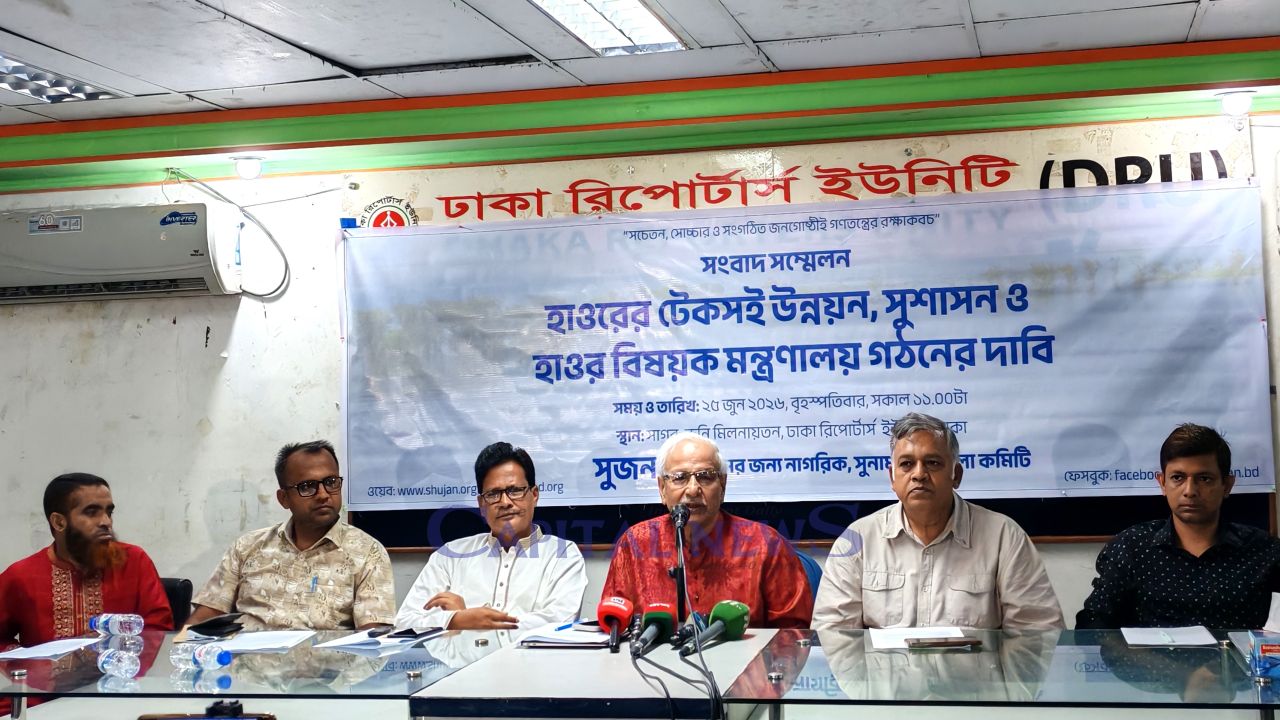
MM Rahmatullah: Shushashoner Jonno Nagorik (SHUJAN), Sunamganj district committee, has called for the establishment of a separate Ministry of Haor Affairs to ensure sustainable development, effective governance, and the protection of Bangladesh’s food security and environment.
The demand was raised at a press
conference held at the Dhaka Reporters Unity on Thursday, where SHUJAN
Secretary Dr. Badiul Alam Majumder highlighted the challenges, potential and
long-term development priorities of the country’s haor region.
Speakers at the event described the
haor basin, spread across seven districts, as one of Bangladesh’s most valuable
natural resources. Sunamganj, the country’s largest haor district, plays a
vital role in national food production. According to information presented at
the press conference, boro paddy was cultivated on approximately 223,511
hectares across 193 haors in the district during the current season, producing
nearly 1.3 million metric tonnes of rice.
The speakers emphasized that the
haor ecosystem is not only crucial for agriculture but also serves as an important
breeding ground for indigenous fish species, a reservoir of biodiversity, and a
key component of the country’s climate resilience. However, they warned that
flash floods, hill runoff, silted rivers and canals, waterlogging, unplanned
infrastructure projects, and corruption are placing the region under increasing
threat.
SHUJAN alleged that despite hundreds
of crores of taka being spent annually on crop protection embankments; farmers
continue to suffer significant losses. In 2026, around Tk 146 crore was
allocated for the construction and rehabilitation of 602 kilometres of
embankments through 710 Project Implementation Committees (PICs) across 12
upazilas of Sunamganj. However, the organisation claimed that irregularities
persist at various stages of implementation.
According to the speakers, delays in
project execution, poor-quality construction, political influence, and a lack
of accountability have prevented embankment projects from delivering the
desired outcomes. In some cases, they said, embankments have obstructed natural
water flow and contributed to new waterlogging problems.
The organisation argued that
although several ministries—including agriculture, water resources, fisheries,
environment, local government, and disaster management—currently work on
haor-related issues, a lack of coordination undermines effectiveness. To
address this, SHUJAN proposed the formation of a dedicated Ministry of Haor
Affairs that would bring agriculture, water management, fisheries, biodiversity
conservation, environmental protection, and disaster management under a unified
framework.
Concern was also expressed over the
environmental degradation of the haor ecosystem. Speakers noted that while 140
to 150 species of indigenous fish were once found in the region, the number has
now declined to around 60 to 70 species. They attributed the decline to
excessive pesticide use, water pollution, encroachment and filling of canals
and wetlands, and the destruction of fish breeding habitats.
To strengthen biodiversity conservation,
the organisation stressed the importance of planting native hijal and koroch
trees along embankments. Such species, they said, help prevent soil erosion,
create fish habitats, and reduce the risks associated with lightning strikes.
As part of its long-term vision for
the haor region, SHUJAN presented a 10-point set of recommendations, including
river, canal, and wetland dredging; science-based water management;
environmentally sustainable agriculture; establishment of fish sanctuaries;
reform of wetland leasing systems; protection of genuine fishermen’s rights;
and stronger conservation measures for Tanguar Haor.
The speakers also highlighted
shortcomings in healthcare services in the region. They noted that although
infrastructure development of Sunamganj Medical College has been completed, the
hospital has yet to become fully operational. They urged the government to
allocate the necessary funds in the 2026–27 national budget and ensure that the
medical college hospital becomes functional by August next year.
Speakers said in the press conference, protecting the haor region is not merely about safeguarding a geographical area but about securing the nation’s food security, ecological balance, and the interests of future generations. They called for a science-based, environmentally responsible, and participatory approach to integrated haor management.
শুক্রবার, ২৬ জুন ২০২৬
Publish Date : 25 June 2026




Write Your Opinion