

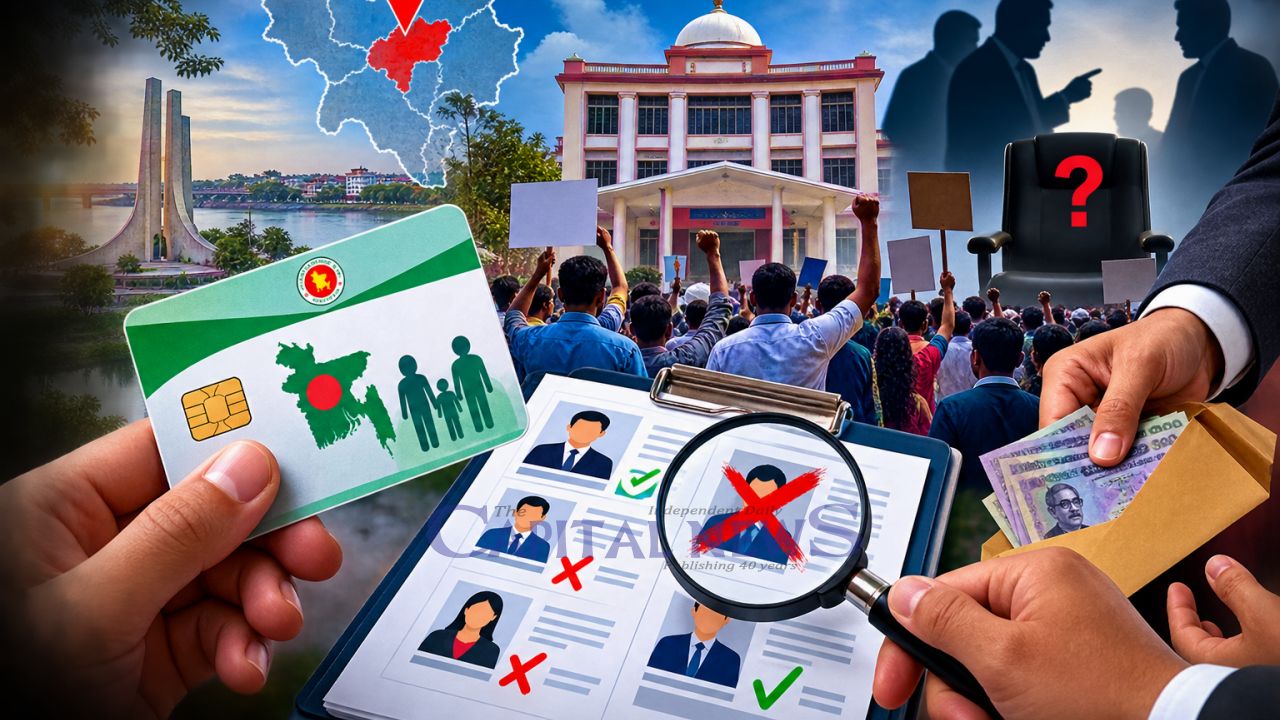
Rajshahi Bureau: A government initiative designed to identify poor families and build a reliable database for social protection has run into controversy in Rajshahi even before the beneficiary list is prepared.
The recruitment of field-level data collectors and supervisors for the Family Card programme has triggered allegations of political influence, favouritism and irregularities in several upazilas of the district. Protesters have demanded that recruitment results be reviewed or cancelled, while in some places they have called for the removal of the respective upazila nirbahi officers (UNOs).
The allegations have surfaced in Godagari, Tanore, Bagmara, Charghat and Bagha, although the nature of the complaints varies from one upazila to another.
At the centre of the controversy is a basic question: Were candidates selected primarily on the basis of merit and the prescribed recruitment rules, or did political connections and recommendations influence the process?
The concerned UNOs, however, have rejected allegations of political bias and said the recruitment was conducted in accordance with the relevant rules.
Protests in Godagari
The controversy became particularly visible in Godagari on August 9, when BNP and its affiliated organisations staged a procession and rally alleging irregularities and political bias in the recruitment of Family Card data collectors.
After the rally in front of the upazila administrative building, protesters went to the UNO's office and demanded verification of the recruitment list and the entire selection process.
According to the protesters, political identity and recommendations from influential quarters were given greater importance than qualifications and merit.
The administration, however, did not acknowledge the allegations.
105 posts spark tension in Tanore
In Tanore, tensions emerged after the recruitment list for 96 data collectors and nine supervisors was published.
BNP and affiliated organisation leaders alleged that the prescribed rules had not been properly followed and that political influence and recommendations had played a role in the selection.
On August 10, they staged demonstrations and a human chain on the upazila parishad premises, demanding cancellation of the list and a fresh recruitment process. They also demanded the removal of UNO Naima Khan.
Khan rejected the allegations, saying the results had been published after following the relevant rules and maintaining transparency.
She also said that if any irregularity was found in the recruitment of any individual, the matter would be investigated and appropriate action taken.
Allegations of Awami League, Chhatra League links in Bagmara
In Bagmara, BNP and its affiliated organisations held a human chain on August 11, alleging that people associated with the Awami League and Bangladesh Chhatra League were being appointed as Family Card data collectors and supervisors.
The protesters also accused the UNO and the upazila social services officer of political bias.
UNO Selim Ahmed denied the allegations, saying the recruitment process had been conducted transparently and in accordance with the rules.
He said there was no scope for favouritism in the process.
Candidates claim they were excluded despite passing
In Charghat, the controversy has taken a different turn.
Several candidates have alleged that they were excluded despite passing the written examination and completing other stages of the recruitment process. They claimed that political lobbying had become an important factor in securing appointment.
One particularly contentious allegation involves an honours student of Rajshahi Women's College, who claims she was denied appointment after being labelled a drug addict.
The student and her family have rejected the allegation and claimed that she was subjected to false accusations.
Upazila Social Services Officer Rasheduzzaman, however, said an intelligence investigation report had identified the student as a drug addict.
UNO Jannatul Ferdous said the recruitment was conducted in accordance with the prescribed procedures and rules, and that no qualified candidate had been unlawfully deprived of appointment.
The conflicting claims highlight the importance of transparency in any background verification process that can directly affect a candidate's employment prospects.
Examination itself comes under scrutiny in Bagha
In Bagha, controversy emerged even before the final recruitment results.
A section of candidates complained of poor internet connectivity and server-related complications during the recruitment examination.
After the results were published, BNP and Chhatra Dal activists staged demonstrations. The results were subsequently suspended, and the application period was extended.
Meanwhile, the UNO of Bagha was transferred. The Rajshahi divisional commissioner said the transfer had no connection with the protests and was part of the regular administrative process.
Politics at the heart of the dispute
The disputes across Rajshahi reveal a complicated political dimension.
In some cases, BNP and its affiliated organisations have alleged that people linked to the Awami League and its associate organisations were being favoured. Elsewhere, complaints have focused on the alleged failure to give recognition or consideration to BNP and Chhatra Dal activists.
This creates a particularly sensitive situation for a government social protection programme. A recruitment process intended to collect information about poor households should ideally be insulated from partisan political considerations.
Rajshahi Deputy Commissioner Kazi Shahidul Islam said UNOs had been instructed to follow the relevant recruitment rules strictly.
He said the UNOs were following those instructions and that there was no opportunity for irregularities.
At the same time, he observed that the recruitment process could have been easier and more transparent if the ministry had managed applications online.
Why the recruitment controversy matters
The dispute is not merely about temporary jobs.
The data collectors and supervisors recruited under the Family Card programme are expected to gather information that will form the basis of a database of poor families.
That means the quality and neutrality of the field workforce could have consequences beyond the recruitment itself.
If field workers are selected through political influence—or if there is a widespread perception that they are—questions may later arise over whether household information was collected objectively.
For example, if a field worker favours or excludes particular families because of political affiliation, personal connections or local pressure, the resulting database could fail to accurately represent the people the programme is intended to support.
That, in turn, could affect the selection of beneficiaries and undermine public confidence in the programme.
Transparency needed from the outset
The allegations in Rajshahi have not been established as proven wrongdoing in every case. The authorities have consistently maintained that recruitment was conducted under the prescribed rules, while protesters and unsuccessful candidates have made allegations that require verification.
The most important issue, therefore, is not simply whether one political group or another has benefited.
It is whether the recruitment process can withstand independent scrutiny.
A transparent review could help resolve the competing claims. Publishing recruitment criteria, examination results, selection scores, verification procedures and the reasons for excluding candidates—where legally permissible—would make it easier for applicants and the public to understand how decisions were reached.
The government could also consider strengthening digital application and examination systems, maintaining clear records of every stage of selection and establishing an effective mechanism for candidates to challenge decisions.
The Family Card programme is ultimately intended to help vulnerable families. Its credibility will depend not only on who receives the cards, but also on whether the system used to identify those families is seen as fair, evidence-based and free from political influence.
For Rajshahi, the recruitment controversy has therefore raised a warning at the very beginning of the programme: before the state can build a trustworthy database of poor families, it must first convince the public that the people collecting that information were themselves selected through a trustworthy process.
শনিবার, ১৫ আগস্ট ২০২৬
Publish Date : 15 August 2026

Write Your Opinion