

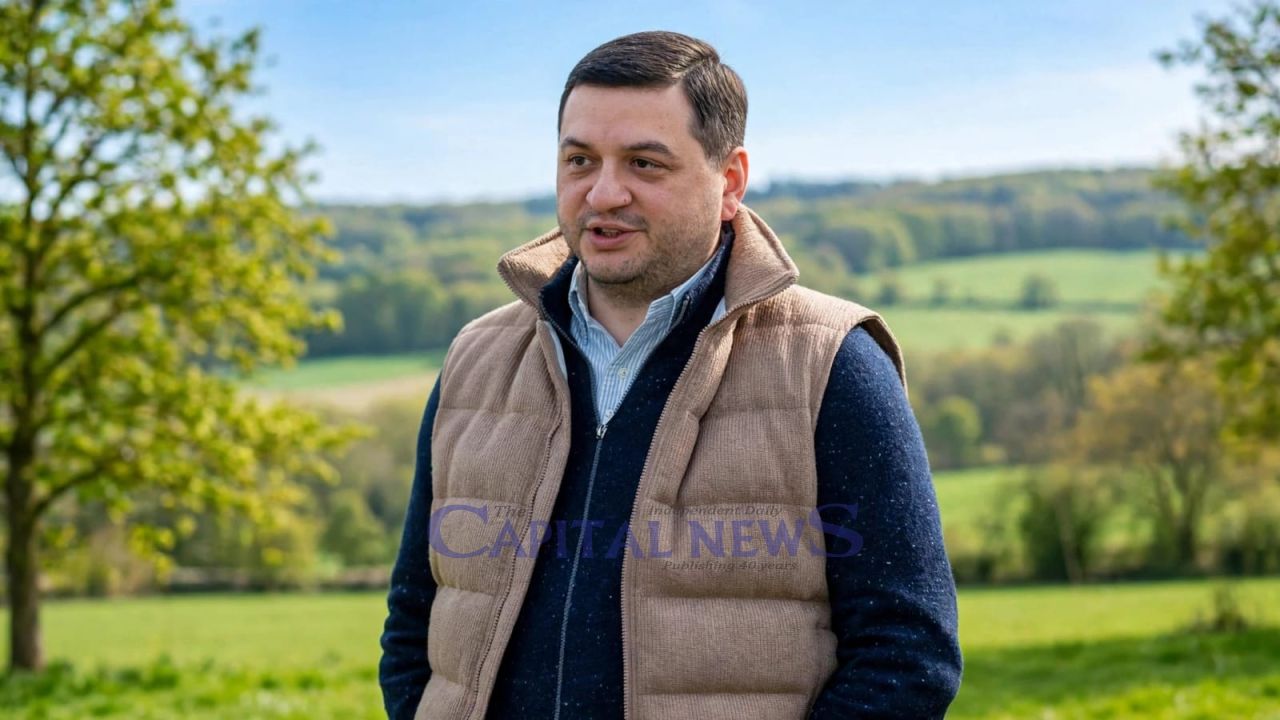
Mr. Otari Katamadze, Honorary Consul of Bangladesh in Georgia, in an interview with Imtiaz Ahmed and Samia Tabassum, said that Bangladesh holds the prospect of exporting skilled manpower to Georgia, an Eastern European country. Georgia's birth rate hit a 32-year low last year, and the country has lost young people to emigration over the years.
That means real labour shortages in construction, hospitality, agriculture and services, and yes, there is room for skilled Bangladeshi workers. What matters to us is that this happens properly: technicians, nurses, engineers, IT specialists, under agreements that recognise qualifications and protect workers. Georgia has built its economy partly on openness to foreign professionals, and we can do the same here. As for our community:
Georgia sits on the corridors connecting China, the Middle East and South Asia to European markets, he said.
1. Dhaka-Tbilisi relations after the February 12 election
First of all, congratulations to my Bangladeshi friends. The February 12 election was a genuinely historic moment for your country, a free parliamentary vote after a turbulent period, and Prime Minister Tarique Rahman won a clear, strong mandate. Political clarity like that is a gift to everyone who wants to build relations with Dhaka. And here is why I am personally optimistic: Georgia is exactly the kind of partner a new government looks for, stable, open, neutral, sitting between Europe and Asia, with no geopolitical baggage toward South Asia. Our diplomatic relations go back to 1992, and the human warmth between our two peoples has always been there; what has been missing is structure. In the coming months I would expect more ministerial contacts, trade delegations, and cultural events, and as Honorary Consul, my job is to make sure none of those chances slip through the cracks. For Georgia, Bangladesh is not just a trading partner of 178 million people; it is a bridge to South Asia. That is worth building on now, while the new government is setting its priorities.
2. Skilled manpower and the Bangladeshi community in Georgia
Let me be honest about our demographics: Georgia's birth rate hit a 32-year low last year, and for decades we have lost young people to emigration. That means real labour shortages in construction, hospitality, agriculture and services, and yes, there is room for skilled Bangladeshi workers. What matters to us is that this happens properly: technicians, nurses, engineers, IT specialists, under agreements that recognise qualifications and protect workers. Georgia has built its economy partly on openness to foreign professionals, and we can do the same here. As for our community: today there are roughly a hundred Bangladeshis living in Tbilisi and Batumi, small business owners, some married into Georgian families, plus a growing number of Bangladeshi students in our universities. It is a seed community. Georgians are famously hospitable people; we will take care of our guests. But I would encourage more of them to come, to study, to trade, to live. The more ties between ordinary people, the stronger everything else becomes.
3. The business environment in Bangladesh
As a Georgian who has spent his life doing business in a small, open, emerging-market economy, I understand what Bangladesh is trying to do. Your new government has made the business environment a stated priority, and the appetite for reform is visible. What strikes me most is the scale: a workforce of over 100 million working-age people, the world's second-largest garments industry, deep capabilities in pharmaceuticals, leather, jute and IT services, and a consumer market still growing. The challenges are real, energy costs, macroeconomic adjustment, moving beyond assembly into higher value-added production. But Georgian investors know this terrain well; we have done exactly this kind of climb ourselves since independence. I would say to any Georgian entrepreneur: come and look for yourself. Dhaka is not far from Tbilisi by air, the culture is warm, and the opportunity is genuinely large.
4. Raising trade between Bangladesh and Georgia
Our bilateral trade today is only a few million dollars a year, which, between two countries with our economies, is almost embarrassing. The problem is not demand; it is awareness and logistics. From our side, I see it simply: Georgian wine, dried fruits, mineral waters and food products have a natural, underserved market in Bangladesh, imagine Georgian wine on shelves in Dhaka. And your readymade garments, pharmaceuticals, leather and jute products can reach Georgia, and through Georgia, Europe and the wider region. This is where our geography becomes an asset: we sit on the corridors connecting China, the Middle East and South Asia to European markets. A company in Chittagong that wants to sell into Europe should think of Tbilisi as a gateway. Concretely: chamber-to-chamber contact, trade delegations in both directions, an agricultural memorandum, and direct flights. None of these needs grand treaties to start. It starts with business people meeting businesspeople, and that is precisely what I intend to organise from here.
5. Energy security: how Bangladesh and Georgia can work together
You are right to be worried, and so are we. When the Strait of Hormuz became unstable this year and oil pushed past 100 dollars a barrel, every country importing energy felt it, including Georgia, though we are much less dependent on Gulf LNG than you are. Any nation that routes its energy through one or two chokepoints carries a risk it cannot fully control. Where we can help each other is practical. First, Georgia is part of the southern energy corridors that move gas and power away from those Gulf chokepoints, keeping and expanding those corridors serves both our interests. Second, we have serious experience in hydropower and renewables, and Bangladesh has enormous solar and offshore wind potential; there is room for joint ventures, technical cooperation, and sharing of expertise. Third, we should speak together in international forums on energy pricing and supply security. I will not overstate it: we are not going to become each other's main energy suppliers overnight. But corridor investment, renewable partnership, and shared advocacy are all within reach, and they fit naturally into a friendship that is otherwise still young.
6. Scholarships for Bangladeshi students
This is something I can answer with pride, because it touches home. Georgian universities are among the best value in Europe, many teach in English, tuition is affordable by Western standards, and our medical schools have a long reputation. Students from South Asia already choose Georgia in meaningful numbers. What is missing is a structured, visible scholarship channel, and I believe both governments should create one: dedicated scholarships for Bangladeshi students in medicine, engineering, IT and the natural sciences, paired with Bangladesh formally recognising Georgian degrees and hosting Georgian students in return. Education moves faster than trade. A generation of Bangladeshi doctors and engineers trained in Tbilisi becomes a permanent bridge between our countries, and personally, I want more of them here. Georgia is a safe, welcoming place to study, and our students will make them feel it.
7. Fifty-four years of Bangladesh's economic development
As a Georgian, I understand what it means to build a nation from scratch after war and collapse, so when I look at Bangladesh's fifty-four years, I look with genuine admiration. In 1972 you were born into war, debt and famine. Today you are a middle-income country of nearly 180 million people, with per-capita income that has grown several-fold since independence and growth above six percent for much of the last fifteen years. You lifted tens of millions out of extreme poverty, built the world's second-largest garment industry, pioneered microfinance all the way to the Nobel Prize, and invested in girls' education and health at a scale the region did not expect. I will not pretend the story had no setbacks, and the past couple of years tested you severely. But the arc is unmistakable: from one of the poorest countries on earth to a middle-income economy whose per-capita income now rivals India's. Georgia and Bangladesh share something rare, two post-colonial nations that rebuilt themselves without waiting for anyone's permission. That is a friendship worth celebrating, and the task ahead for you, jobs, energy, moving up the value chain, is one we recognise well.
8. Social unrest in Europe
What is happening across France, Germany, Italy, Spain, Greece and other countries is, at its core, a cost-of-living crisis hitting a generation that feels betrayed. Young Europeans are protesting rising rents and prices, underfunded schools and universities, weak job prospects, and, in Germany specifically, the reintroduction of compulsory military service, which they read as spending priorities turning against them. Add the fuel-price shock from the war in the Middle East, heavy government deficits, and deep distrust of politicians, and you get what we are seeing: students filling Paris, strikes in Berlin and more than thirty other German cities, riots in Milan, tents outside the Greek parliament. One thing commentators often miss: these are largely domestic grievances, the protesters are mostly citizens of their own countries, not immigrants. Seen from Georgia, where we remember what it costs a young person to leave, the lesson is clear and uncomfortable: when young people lose hope in their own future, instability follows everywhere, in every country, without exception.
9. The prospect of a Blue Economy in Bangladesh
I see it as one of the most promising frontiers your country has. After the international tribunal ruling expanded your maritime zone, Bangladesh controls a far larger area of the Bay of Bengal than most people realise, with fisheries, aquaculture, offshore wind potential, shipping and shipbuilding, port development, and coastal tourism around Cox's Bazar, the longest natural sea beach in the world. Layer in blue-carbon opportunities from the Sundarbans mangroves, and you have a whole second economy sitting right off your coast. As someone from a Black Sea country, I know both the promise and the discipline this requires: develop the sea without destroying it, because the same climate shocks that threaten your delta will punish any careless exploitation. Done properly, the Blue Economy could be as transformative for Bangladesh as garments were in the 1990s. And it is an area where we could engage constructively too, Georgia has its own experience in Black Sea fisheries, port logistics and coastal tourism. Two littoral countries, sharing lessons.
Subject : Diplomacy
সোমবার, ২৩ নভেম্বর ২০২৬
Publish Date : 13 November 2026




Write Your Opinion