

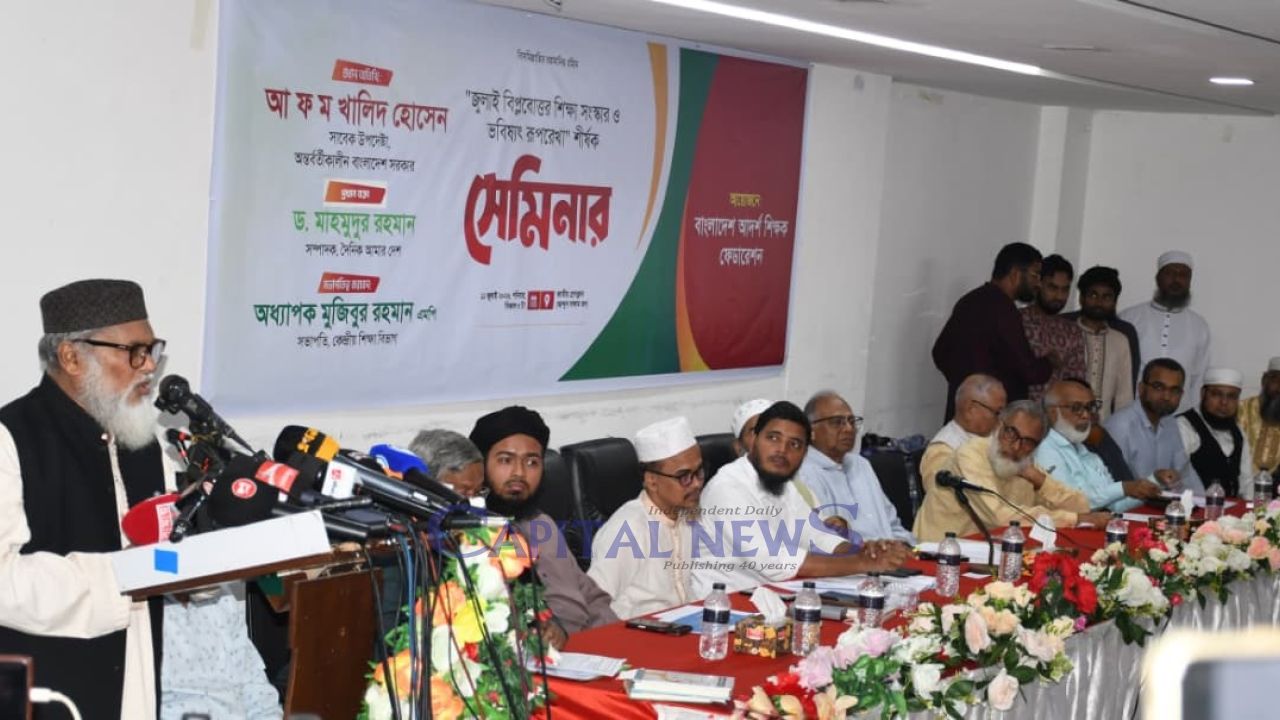
MM Rahmatullah: Speakers at a seminar on the future of Bangladesh's education system called for comprehensive reforms aimed at building an education framework that is modern, equitable, skills-oriented and rooted in ethical values.
They also stressed the need to end political influence in educational institutions, increase investment in research, ensure merit-based recruitment and strengthen moral and religious education.
The seminar, titled "Post-July Uprising Education Reform and Future Roadmap," was organised by the Bangladesh Ideal Teachers' Federation at the Abdus Salam Hall of the National Press Club on Saturday. The event was presided over by Prof. Mujibur Rahman, adviser to the federation and president of the central education department of Bangladesh Jamaat-e-Islami.
Addressing the seminar as chief guest, former adviser to the interim government AFM Khalid Hossain alleged that the country's education system between 2009 and 2024 had undermined national identity. He also claimed that a section of the administration had developed a secular outlook and emphasised the need for far-reaching reforms incorporating religious, moral and ideological education from the primary to the tertiary level.
Delivering the keynote address, Amar Desh Editor Dr Mahmudur Rahman said the existing education system had failed to produce a skilled workforce capable of competing internationally. He called for a discrimination-free education system, greater diversity in textbooks and subject-based publications, and urged teachers to remain free from partisan politics. Political involvement of teachers, he said, had encouraged partisan recruitment and administrative appointments, depriving qualified candidates of opportunities. He also remarked that the July movement had strengthened the confidence of the country's younger generation and stressed the importance of nurturing them with ethical and moral values.
Former Chairman of the Department of Chemistry at Jahangirnagar University, Elias Molla, MP, said the country's education system had become directionless. He called for a new education policy with clearly defined objectives to promote justice-based leadership and national development.
Dr Shafiqul Islam Masud, MP, a member of the central executive council of Bangladesh Jamaat-e-Islami and secretary of its Dhaka South unit, said meaningful state reform could be achieved through education reform, provided the government demonstrated genuine commitment. He alleged that the lack of merit-based evaluation, along with partisan and nepotistic practices, had contributed to the growing brain drain from the country. He also made political remarks regarding former Prime Minister Sheikh Hasina.
Reserved-seat lawmaker Rokeya Begum, mother of martyred Jaber Ibrahim, said genuine education reform would not be possible without broader state reforms. She called for constitutional reforms and implementation of any public mandate on the issue through a referendum.
Former Senior Secretary of the Technical and Madrasah Education Division Dr Kh M Kabirul Islam said Bangladesh's education system had suffered extensive setbacks and required a complete overhaul. He cited the growing trend of highly educated graduates applying for low-ranking jobs as evidence of the system's shortcomings.
DUCSU Vice-President Sadik Kayem criticised the lack of emphasis on research in Bangladesh, noting that developed countries place education and research at the centre of national progress. He expressed concern over the absence of a dedicated research allocation in the University of Dhaka's budget and urged the government and university authorities to adopt a more supportive approach towards students and academic development.
Islamic scholar and author Mufti Ali Hasan Usama advocated for a discrimination-free education policy and proposed making Qur'an and Hadith education compulsory from the primary level. He also called for eliminating social discrimination against madrasa students.
The seminar began with the presentation of a keynote paper by Prof. Zubair Muhammad Ehsanul Haque of the University of Dhaka. The programme was moderated by Prof. Rabiul Islam, president of the Dhaka South unit of the Bangladesh Ideal Teachers' Federation.
Among others, Prof. ABM Fazlul Karim, secretary general of the federation; Mufti Maulana Khalilur Rahman Madani, acting principal of Tamirul Millat Kamil Madrasah; Prof. Dr Shamsul Alam of the University of Dhaka; and Dhaka Union of Journalists President Md Shahidul Islam also addressed the seminar.
In his concluding remarks, Prof. Mujibur Rahman described education as a key instrument for developing moral character and promoting social welfare. Referring to the teachings of the Qur'an, he called for the appointment of Qur'an teachers at every level of education and proposed making Islamic Studies a compulsory subject instead of an optional one. He also urged the authorities to ensure teacher recruitment solely on the basis of merit, free from political considerations.
Representatives from the Public University Teachers' Council, Private University Teachers' Council, College Teachers' Council, Madrasa Teachers' Council, Technical Teachers' Council, Secondary School Teachers' Council, Primary School Teachers' Council and Kindergarten Teachers' Council, along with educationists and organisational leaders, attended the seminar.
রোববার, ১২ জুলাই ২০২৬
Publish Date : 12 July 2026
Write Your Opinion